


Nine at Night in Saraswathi Nagar, the Match Is On, and the Screen Goes Black
It is nine on a June evening in a Saraswathi Nagar living room. A thunderstorm has been rolling over the city for an hour, the kind that opens Davanagere's monsoon, and the family is watching the match. The lights flicker, and when they steady the TV is showing nothing: sound carries on for a moment, then the set goes silent and the standby light blinks. Someone says the TV is finished. It almost certainly is not. A surge has come through the socket and taken out the power supply board or the backlight driver, both of which are repairable at home. This page takes an LED television apart on paper, explains what each board and layer does and how Davanagere's heat, dust and storms wear it, and sets out how AC Care India approaches LED TV repair in Davanagere.
The Power Supply Board: First in Line for Every Surge
Mains electricity enters the TV through the power supply board, which converts it to the low voltages the rest of the set needs. It carries a fuse, a varistor that absorbs spikes, a bridge rectifier and several capacitors. When a storm surge arrives through a socket with no proper earth, which is common in the older houses of Doddapete, Mandipet and Chamaraj Pete, this board takes the hit. The signs are a completely dead set, a standby light that blinks but will not start, or a TV that switches on and off by itself. Capacitors also age faster in a hot room, bulging and leaking after years of 38°C afternoons. Most of these faults are repairable at component level, and we fix the board rather than replace it where that makes sense.
The Backlight: LED Strips, the Driver and the Heat Problem
Behind the LCD panel sit rows of white LEDs on strips, powered by a driver circuit. They are what make the picture visible. In Davanagere, two things shorten their life: heat and brightness. A TV mounted on a west-facing wall in a room that gets the afternoon sun runs its backlight hot, and a set left at maximum brightness all day pushes the LEDs hard. When one LED fails, the driver detects the open circuit and shuts the whole backlight off. You get sound but a black screen; shine a torch at the panel and a faint picture appears. That single test confirms the backlight and rules out the panel, and it is the most repairable fault a TV can have.
The Mainboard: Smart Features, Ports and Software
The mainboard holds the processor, memory, Wi-Fi, HDMI and USB ports and the tuner. It runs the smart TV's apps. Faults here show as slow menus, apps that freeze, no Wi-Fi, HDMI inputs that are not detected, or a TV that boots and then restarts. Some are software and clear with a firmware update or a factory reset. Some are hardware: a loose HDMI port from years of cable swapping, a failed memory chip, a surge-damaged regulator. Dust is a factor on this board too, because Davanagere's dry months coat every circuit in the house and dust traps heat.
The T-Con Board and Flex Cables: Lines and Bands
Between the mainboard and the panel sits the timing controller, or T-con, which tells the panel's rows and columns what to show. It connects through flat flex cables. When it fails or a cable loosens, you see vertical lines, a band of frozen picture, double images or a screen that is half normal and half noise. Many people are told this is the panel. Sometimes it is, and we say so when it is. Often it is the T-con or a cable, both of which can be replaced.
The Panel: The Honest Part of the Conversation
The LCD panel is the screen itself. A cracked panel, dark patches from pressure, a spreading blotch or lines that persist after the T-con and cables test fine mean the panel has failed. On a large or older set, a new panel often costs close to a new television, and we will tell you that at the door rather than after a day of work. On a small or recent set it may be worth doing. Either way, you get the straight answer.
Speakers, IR Receiver and the Rest
Speakers and the audio amplifier fail with humidity after the rains and with age; a picture without sound points here. The IR receiver that reads the remote dies quietly and makes a working TV look dead. Backlight dimming on one side, a slow-to-start set, or a faint buzz from the back all have specific causes, and a technician who tests rather than guesses finds them in minutes. Screen sizes in the city have grown quickly, with 43 and 55-inch sets now ordinary in living rooms that once held a 32-inch, and larger panels mean more backlight strips, more heat and more to go wrong, which is one more reason to keep the brightness setting sensible and the wall cool.
Diagnostics We Run on Every TV
- Check the socket for voltage and a working earth; many Davanagere faults start at the wall.
- Listen for sound and run the torch test to separate backlight from panel.
- Test the power supply board's outputs, fuse, varistor and capacitors.
- Test each backlight strip and measure the driver's output.
- Check the T-con board and reseat or replace flex cables.
- Test HDMI, USB and antenna ports, speakers and the IR receiver.
- Read the mainboard's firmware version and update or reset where relevant.
- Clean dust from the boards and the backlight cavity.
- Quote before replacing anything, then test the set for a full hour before leaving.
Component Life and Warning Signs in a Davanagere Living Room
| Part | Typical Life Here | Warning Sign |
|---|---|---|
| Power supply board | 6 to 10 years; much less without surge protection | Dead set, blinking standby, random restarts |
| Backlight LED strips | 5 to 8 years at high brightness on a hot wall | Sound but black screen, dim half of the picture |
| Backlight driver | 6 to 9 years | Screen flickers then goes black |
| Mainboard | 7 to 10 years | Frozen apps, no HDMI, boot loops |
| T-con board and flex cables | 6 to 10 years | Lines, bands, double images |
| Panel | 8 to 12 years if not damaged | Cracks, dark patches, persistent lines |
| Speakers | 7 to 10 years | Crackle, no sound with picture |
| HDMI ports | Depends on handling | Input not detected, intermittent picture |
Wall Mounting, Shifting and Set-Up
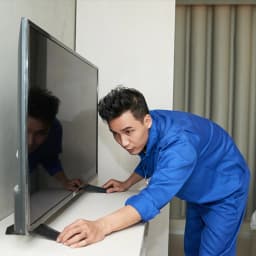
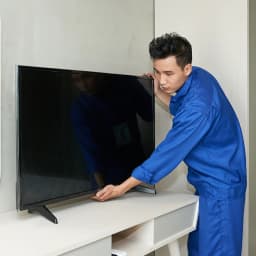
We mount TVs on brackets rated for the set's size, away from the afternoon sun where the wall allows, with ventilation space behind the set, and we route cables so HDMI ports are not strained. When you move within Davanagere we pack, transport-ready and remount the set, because a large panel carried flat in an auto is how cracks happen. We also set up DTH and OTT, update firmware and connect Wi-Fi, since a growing share of "the TV is not working" calls in the student areas turn out to be a box subscription or a router reset rather than a fault in the set, and we will say so rather than invent a repair.
Brands We Repair
Samsung, Sony, Mi and Xiaomi, TCL, OnePlus, Vu, Panasonic, Thomson and Realme LED and smart TVs, from small bedroom sets in rented rooms to large living-room screens, plus the TVs in lodges around the bus stand. We carry backlight strips, power boards and common capacitors and source mainboards and T-con boards quickly for popular models.
AC Care India is an independent multi-brand repair service and is not the authorised service centre of any television manufacturer. Brand names appear only to identify the sets we work on. A TV still under the maker's warranty should go to the brand first.
Davanagere Neighbourhoods We Cover
Saraswathi Nagar, Vidyanagar, MCC A Block, MCC B Block, PJ Extension, Nittuvalli, Shamanur Road, Siddaveerappa Badavane, Jayadeva Circle, Bapuji Nagar, Basaveshwara Nagar, SS Layout, Kuvempu Nagar, Anjaneya Badavane, Hadadi Road, Bethur Road, Shivaji Nagar, Taralabalu Badavane, Doddapete, Mandipet, Chamaraj Pete, Azad Nagar, KTJ Nagar, Gandhi Nagar, Lokikere Road and Avaragere.
Book LED TV Repair in Davanagere
With AC Care India you get identity-verified technicians who test before they condemn a part, a written quote before work, warranty on the repair and the parts, genuine or quality-compatible boards with the old one shown to you, same-day or next-day visits in most of the city, and an honest word when the panel has gone. Call or WhatsApp 9266608882, or book online through this page. Tell us the brand, screen size, whether there is sound, and whether the fault followed a storm, and we will send a technician with the likely parts.
