

A Black Screen Rarely Means the Panel Is Gone
When an LED TV in Junagadh goes dark, the first thing many owners hear, from a neighbour or a shopkeeper, is that the "panel has gone" and the set is finished. In most cases that is simply not true. A screen that shows nothing can be a failed backlight strip, a damaged power supply board, a loose cable, a software crash or even a set-top box problem. The panel, the actual glass display, fails far less often than people think. When it does, it is usually because of a physical crack, a pressure mark or liquid damage.
Knowing the difference can save you from throwing away a television that only needed a backlight repair. This page explains how Junagadh's climate and housing affect TVs, how to read the symptoms, what our technicians do on a visit, and how to decide whether LED TV repair in Junagadh is worth it for your set.
Summer Heat and Dust Inside the Back Panel
From April to June, Junagadh afternoons climb into the low forties. An LED TV produces a good deal of heat of its own, mostly from the LED backlight strips behind the screen and from the power supply board. In a room that is already very warm, the components run hotter than they were designed for. Electrolytic capacitors dry out, LED chips dim and burn open one by one, and solder joints on the boards crack from repeated heating and cooling. Summer holidays, when children watch for hours, add to the load.
The dry season also brings dust. Fine particles blow in from open land and roads and get drawn into the TV through the vents at the back. A dust layer on the power board acts like a blanket and traps heat. Sets placed inside closed wooden cabinets or flush against a sun-heated wall suffer most.
Monsoon Storms, Damp Walls and Surges
When the monsoon arrives in mid-June, Junagadh often sees intense thunderstorms. The city sits at the foot of Girnar, and heavy rain on the hills has brought serious flooding to parts of town in recent years. For televisions, the storm season means three things.
Lightning and surges. A nearby strike or a fault on the line sends a spike through the mains. The power supply board takes the hit first, but a surge can also travel through the DTH dish cable from the roof straight into the set-top box and the TV's HDMI port.
Sudden outages and restoration. Repeated trips during a storm switch the TV off and on in quick succession, stressing the power board.
Humidity and seepage. Wall-mounted TVs on walls that get damp during the rains are exposed to moisture behind the set. Combined with summer dust on the boards, that moisture can create leakage paths and corrosion.
Simple protection that pays for itself
A good-quality surge protector, not a basic multi-plug, between the wall and the TV is the single most effective step. Plug the set-top box into the same protector so both share one protected path. During a severe storm, switch off at the wall and pull out the DTH cable from the set-top box if you can. When power returns after a long cut, wait a minute or two for the supply to steady before turning the TV on. If your TV hangs on a wall that shows damp patches each monsoon, consider moving it, or at least leave a gap behind it for air to circulate. These habits cost little and prevent most of the storm-season failures we see.
Junagadh Homes, Wiring and Cable Runs
The kind of home you live in shapes the risks. In older houses within the walled city, near Diwan Chowk, Azad Chowk and Majevadi Gate, wiring is often decades old, with shared sockets and weak or missing earthing. A TV, set-top box, soundbar and router plugged into one multi-plug on that wiring is vulnerable. In newer apartments along Zanzarda Road, Timbawadi and Joshipura, large TVs are typically wall-mounted, and the DTH cable runs a long way from a dish on the terrace, which makes it a good path for surges. Bungalow homes in Motibaug and Bhavnath often have the TV in a large hall with windows facing the afternoon sun, which heats the screen and the boards behind it.
Symptoms and What They Usually Point To
| Symptom | Common Cause | Panel Problem? |
|---|---|---|
| Sound present, screen black | Backlight LED strip failure | No, usually repairable |
| No power, no standby light | Power supply board damage, blown fuse | No |
| Standby light blinks, TV will not start | Power board or main board fault | No |
| Stuck on logo or restarting | Software corruption, main board issue | No |
| Vertical or horizontal lines | T-con board, loose ribbon, or panel fault | Sometimes |
| Cracked glass, ink-like spread | Physical damage to the display | Yes, usually not economical |
| HDMI not detected | Port damaged by surge, faulty cable | No |
| Picture dim with dark patches | Some backlight LEDs failing | No |
What Our Technician Does on a Visit
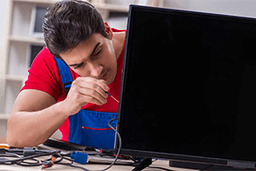
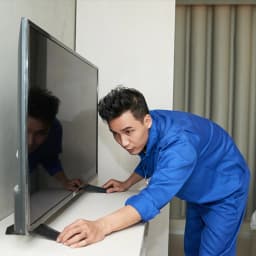
The visit starts with the simple things: the wall socket, extension board, set-top box, cables and input settings. Plenty of "dead TV" calls end there. If the fault is inside the set, the technician takes it down carefully if it is wall-mounted and lays it face-down on a soft surface.
With the back panel off, we inspect the power board for bulged capacitors or burnt components, measure the output voltages, and test the backlight strips with a dedicated tester. The main board and T-con board are checked for supply voltages and signal. On smart TVs, we attempt a software reset or update where that is the issue.
You get a clear explanation of what has failed and a written quote. Backlight, power board and most software repairs are done at your home. Complex board-level repairs may need a workshop visit, and we explain that before anything is moved. After repair, we run the TV for some time and test every input before leaving.
Things to Try Yourself, and Where to Stop
Safe checks at home
- Plug the TV directly into a known working wall socket.
- Unplug for two minutes, then try again with the main power button.
- Check the input source if the screen says "no signal".
- Shine a torch close to a black screen while the sound plays; a faint image means the backlight has failed.
- Restart your Wi-Fi router if apps will not load.
Call a technician if
- You smell burning or see a scorch mark.
- The TV went dead during a storm.
- Lines, patches or flickering appear on the screen.
- The set has been exposed to water or heavy damp.
- Opening the back is needed. LED TVs contain mains voltages on the power board.
Brands We Repair
LED, smart, QLED and 4K televisions from Samsung, Sony, Mi and Xiaomi, TCL, OnePlus, Vu, Panasonic, Realme and Thomson, plus many smaller brands sold in Junagadh shops.
Localities We Visit
Zanzarda Road, Timbawadi, Joshipura, Motibaug, Bhavnath, Diwan Chowk, Azad Chowk, Majevadi Gate, Kalwa Chowk, Jayshree Road, Sardarbaug, Madhuram, Gandhigram, Dolatpara, College Road, Talav Darwaja, Mangnath Road, Vanthali Road, Bilkha Road and Raiji Baug.
Repair the TV or Buy a New One?
For a TV under six or seven years old, a backlight or power board repair is almost always worthwhile. Main board repairs make sense on mid-range and larger sets. A cracked or internally damaged panel is different: a replacement panel often costs close to a new TV, and on most sets we will advise against it. If repair is not sensible, we say so and do not charge you for a fix that will not last.
Age matters in another way too. Older smart TVs may no longer receive app updates, so popular streaming apps stop working even though the hardware is fine. In that case, a low-cost streaming stick often gives the set several more useful years, and we will mention it rather than recommending a board you do not need.
Why Book AC Care India
Our technicians are verified and properly equipped for board and backlight work. You get a quote before work starts, a warranty on repairs and fitted parts, genuine or reliably compatible spares, and same-day or next-day visits in most areas. AC Care India is an independent multi-brand service and is not the authorised service centre of any TV brand; we use brand names only to identify the sets we repair. If your TV is still under warranty, please contact the brand first.
Book LED TV Repair in Junagadh
Call or WhatsApp 9266608882, or book through this page. Share your locality, TV brand, screen size and the symptom, and we will arrange a visit at a time that suits your family.
