


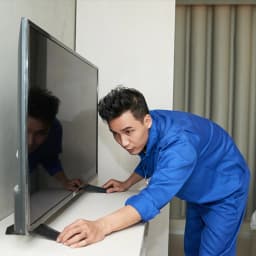
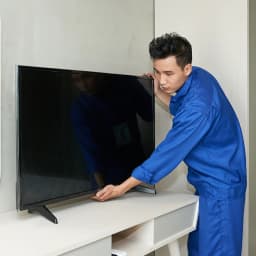
Why Do So Many TVs in Mau Die Right After the Power Comes Back?
It is a question we hear often. The supply goes off in the evening, comes back an hour later with a flicker, and when the family switches on the television, there is nothing: no standby light, or a light that blinks but no picture. The TV was fine before the cut. What happened?
The short answer is a voltage spike. The longer answer involves Mau's power network, its heat, its monsoon storms and the fine fibre dust that drifts from the looms. Understanding those conditions explains most of what we see during LED TV repair in Mau, and it also tells you how to protect your next set.
A Powerloom Town's Electricity and What It Does to Televisions
Mau has been a weaving centre for centuries, and today thousands of powerlooms run in homes and workshops across the town. Many mohallas have residential and loom connections on the same transformers. When dozens of loom motors start or stop together, or when household load peaks in the evening, the voltage swings. During summer, scheduled and unscheduled cuts are frequent in eastern Uttar Pradesh, and when a feeder is restored, the first second of supply can bring a spike well above normal.
A modern LED TV runs on a switch-mode power supply board that is designed for a range of input voltages. It handles slow dips quite well. What it handles badly is a sharp spike. The fuse, the bridge rectifier, the main filter capacitor and the switching MOSFET take the hit. Sometimes only the fuse goes; sometimes the surge travels further and damages the backlight driver or the mainboard.
Inverters add another layer. When a home switches between grid and inverter, there is a brief interruption, and cheaper square-wave inverters produce a rough output that some TV power boards do not like. Over months, that stress accumulates.
Heat, Monsoon Storms and Loom Dust
Heat. Mau's May afternoons average around 42°C, and the hot season runs from April well into June. LED backlight strips generate heat and are packed tightly behind the panel. In a hot room, or with the TV mounted flat against a sun-baked wall, they run hotter still. Heat is the main reason LED strips fail, and summer is when we replace the most.
Monsoon. From late June to September, thunderstorms bring lightning. Surges enter not only through the mains but also through the dish antenna cable and the set-top box connected by HDMI. Damaged HDMI ports and tuner sections are classic monsoon repairs. High humidity in the same months can cause corrosion on board connectors, especially in ground-floor rooms where walls stay damp.
Dust and lint. In homes with looms nearby, fine cotton and synthetic fibre floats in the air and is drawn into the TV's rear vents along with ordinary road dust. It settles on the power board, traps heat, and in damp weather can create tiny leakage paths across components.
Simple Protection That Works in Mau Homes
Most of the damage described above is preventable, and the measures are inexpensive compared with a power board or a panel.
- Use a proper surge protector, not a basic extension board. Look for one with a clear joule rating and an indicator showing that protection is active. Plug the TV, set-top box and soundbar into the same protector, so a surge cannot travel between them through the HDMI cable.
- Switch off at the wall when the power goes. If the TV is off at the socket when supply returns, the restoration spike never reaches it. Switch on a minute or two after the supply has settled.
- Unplug the dish cable during thunderstorms. Lightning-induced surges on the antenna line are a major monsoon cause of tuner and HDMI damage.
- Check your inverter type. A pure sine wave inverter is kinder to TVs and other electronics than an older square-wave model.
- Leave breathing room. Keep at least a few centimetres between a wall-mounted TV and the wall, and avoid mounting it on a wall that takes direct afternoon sun.
- Dust the rear vents gently with a soft brush every month or two, especially in homes near loom workshops.
Families who follow these steps see far fewer of the after-cut failures that fill our diary each summer. A stabiliser is not usually needed for a modern TV, but surge protection is.
Symptoms and Their Usual Causes
| What You See | Probable Fault | Common Local Trigger |
|---|---|---|
| No standby light at all | Power supply board, fuse or MOSFET failure | Spike when supply returns after a cut |
| Sound plays, screen is black | LED backlight strips or backlight driver | Summer heat, long viewing hours |
| Standby light blinks, TV does not start | Mainboard or power board error | Surge damage, corrupted firmware |
| Vertical or horizontal lines | T-con board, panel ribbon or panel fault | Heat stress, physical knock |
| HDMI shows no signal | Damaged HDMI port or chip | Monsoon surge through set-top box |
| TV restarts on its own | Weak capacitors on power board, software fault | Voltage dips, inverter switching |
| Dim or patchy picture | Some LEDs failing, diffuser sheet issue | Heat, ageing |
| No sound or crackling | Speaker or audio amplifier fault | Dust, age |
How a TV Repair Visit Goes
We begin with the basics: confirming that the fault is in the TV and not the set-top box, the cable, the Wi-Fi or a setting. The technician checks the wall socket voltage and any stabiliser or surge protector in use.
Then he looks for error codes, tests the power supply board's output and, if needed, opens the back panel on a clean surface. Power board, HDMI and firmware problems are usually fixed at home. Backlight jobs require the panel layers to be separated without dust getting in; for larger screens, we may carry the TV to our workshop with your written permission and a receipt, then bring it back.
You get the diagnosis and a written estimate before any work begins. After the repair, the TV runs for an extended test on all inputs, and the replaced parts are handed to you.
What You Can Check Yourself, and When to Call Us
Try these yourself:
- Unplug the TV for two minutes, then plug it directly into the wall and switch on.
- Press the menu button. If the menu appears, the TV is working and the source is the issue.
- Shine a torch close to a black screen while sound is playing. A faint image means the backlight has failed.
- Swap the HDMI cable or try another HDMI port.
- Check that the remote's batteries are fresh.
Call a technician if:
- There is no standby light even when connected directly to the wall.
- You smell burning or see marks on the back panel.
- The screen shows lines, cracks or dark patches.
- The TV keeps restarting or is stuck on the logo.
- A storm or cut was followed by total failure.
Never open the back cover yourself. The power board holds a charge even after the TV is unplugged.
TV Brands We Repair in Mau
Samsung, Sony, Mi and Xiaomi, TCL, OnePlus, Vu, Realme, Thomson and Panasonic, across sizes from 32 inch to large smart 4K sets. AC Care India is an independent multi-brand repair service and not the authorised centre of any television brand. Names are used here only to show the sets we work on. If your TV is still under the maker's warranty, please contact the brand first.
With us, you get verified technicians, an estimate before work, warranty on repairs and replaced parts, genuine or tested compatible spares, same-day or next-day visits in most areas, and an honest view on whether your TV is worth fixing.
Areas in Mau Where We Repair TVs
Qasimpura, Chowk, Sahadatpura, Bhiti, Malik Tahirpura, Mirzahadipura, Dakshin Tola, Nizamuddinpura, Shahi Katra, Gazipur Tiraha, Azamgarh More, Balnirmal, Musadpura, Aurangabad, Imliya and Tajopur, with Kopaganj and Paharpura on request.
Repair the TV or Buy a New One?
Power boards, backlight strips, HDMI ports, speakers and firmware are all reasonable repairs, and on a TV under six or seven years old they are usually worth doing. A mainboard depends on availability and model. The display panel is the hard case. Panels are the most expensive part of any TV, and for many models a replacement costs close to the price of a new set, or is not available separately. If your screen is cracked or has a large dead area, we will tell you that replacement is the sensible choice, and suggest how to protect the new one from Mau's surges.
Book LED TV Repair in Mau
Book LED TV repair in Mau online through this page, or call 9266608882. Share the brand, size and symptom, and we will schedule a visit.
