

A Sparking Microwave Is Not Always a Dead Microwave
A common belief in Aizawl kitchens goes like this: the moment a microwave throws sparks or makes a crackling noise, it is finished and should be thrown out. In most cases that is wrong. Sparks inside the cavity usually come from one of three fairly modest problems: a greasy or burnt waveguide cover, a patch of chipped paint that has started to rust, or a metal rim on a plate. All three are repairable. The real danger is the opposite habit, carrying on using a sparking oven until the arcing damages the magnetron, which is the costly part.
Myths like this are why we wrote this page. It explains what Aizawl's climate, power supply and cooking habits actually do to a microwave, what our technicians check during microwave oven repair in Aizawl, and which jobs you can safely do yourself versus the ones you must never attempt.
Damp Air and the Inside of Your Oven
Aizawl spends a large part of the year wrapped in moisture. Rain can start in April and continue into October, and on many monsoon days the kitchen windows stay fogged. A microwave cavity is a painted steel box. When steam from reheating rice, boiling water or cooking vegetables condenses inside and the door is shut straight afterwards, that moisture sits on the paint. Over months, small chips around the turntable support and the door edge begin to rust.
Rusted spots are not just ugly. Bare or rusted metal can arc when the oven runs, and the arc burns the surrounding paint further, enlarging the spot. Humidity also gets into the control panel, where membrane keypads lose response and connectors corrode. The simplest protection costs nothing: after cooking, wipe the cavity dry and leave the door ajar for a few minutes.
Mould and smell in the off season
Ovens that are used only occasionally, especially in homes where the microwave sits in a corner of a cool, damp kitchen, can develop a musty smell and mould spots on the door seal and around the light cover. A periodic clean with mild detergent and a warm cycle with a bowl of water and lemon slices keeps this in check.
Storms, Supply Interruptions and the Electronics
A microwave's electronics include a control board, a high-voltage transformer, a high-voltage capacitor, a high-voltage diode and the magnetron itself. The low-voltage side, the board and its fuse, is the part most exposed to supply problems. In a hill city where pre-monsoon thunderstorms are frequent and power can drop and return several times during a single evening, a spike on return is a regular cause of a dead control panel or a blown internal fuse.
Unplugging the microwave during lightning, or running it on a surge-protected socket, avoids much of this. Avoid using it on the same extension board as an iron or a room heater, because the combined load overheats the board and the plug.
What Aizawl Kitchens Use the Microwave For
Most homes here use the microwave as a helper rather than the main stove: reheating rice and curries, softening vegetables for bai, warming milk and defrosting pork or chicken from the freezer. The defrost habit matters, because long low-power cycles keep the turntable motor and cooling fan running for extended periods. Convection models get their busiest weeks in December, when cakes and cookies come out for Christmas and the New Year. That is when convection heaters, oven fans and thermal fuses are pushed hardest, and when we receive the most calls about convection mode not heating.
Home Inverters, Generators and Your Microwave
Because supply interruptions are part of life in the city, many households and shops run a home inverter battery system, and some buildings share a diesel generator. A microwave is a heavy load. A typical 20 to 25 litre oven draws well over a kilowatt while heating, and convection or grill modes draw even more. Most domestic inverters are sized for lights, fans, a TV and a router, not for that kind of surge.
Running the oven on backup power produces a familiar list of complaints: the inverter beeps and cuts out, the oven display resets halfway through, or the oven hums without heating properly because the voltage sags. Repeated attempts can damage both the inverter and the microwave's board. Generator power brings a different risk, as voltage and frequency can swing when other loads switch on and off.
The practical rule is simple. Wait for mains power to return and stabilise for a minute before using the microwave. If you must run it on backup, check with your inverter installer that the system is rated for it, and never run it at the same time as an iron, geyser or water pump.
Symptoms, Likely Causes and What Happens Next
| Symptom | Probable Cause | Repair Approach |
|---|---|---|
| Runs, light on, food stays cold | Failed magnetron, HV diode or HV capacitor | Safe discharge, component testing, replacement |
| Sparks or crackling inside | Burnt waveguide cover, rusted cavity paint, metal in dish | Replace cover, treat and repaint cavity with microwave-safe paint |
| Completely dead, no display | Blown fuse, door switch fault, control board damaged by surge | Fuse and interlock check, board repair or replacement |
| Turntable not rotating | Worn coupler or failed turntable motor | Replace coupler or motor |
| Keypad not responding | Moisture-damaged membrane or ribbon cable | Clean connector or replace keypad |
| Convection mode not heating | Open heater element or tripped thermal fuse | Continuity test, replace heater or fuse |
| Loud humming or burning smell | Failing transformer or magnetron, shorted HV diode | Stop using immediately; full high-voltage diagnosis |
What Our Technician Does During the Visit
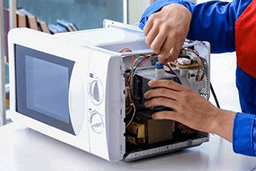
The visit starts with a look at your socket, plug and earthing, since many microwave faults and most shock risks begin there. With the oven unplugged, the technician removes the outer case and safely discharges the high-voltage capacitor before touching anything inside. That one step is why microwave repair is never a do-it-yourself job.
Next come the tests: fuses, door interlock switches and the monitor switch, the magnetron's resistance and insulation, the diode and capacitor, the transformer windings, the turntable motor, cooling fan and lamp. On convection and grill models we test the heaters and thermal cut-outs. The cavity is inspected for rust and damaged paint, and the waveguide cover for burns.
You then get the diagnosis and a quote. After repair, the oven is reassembled and tested with a cup of water to confirm heating, the door seal is checked, and a leakage check is carried out around the door.
Safe to Do Yourself, or Time to Call Us?
You can safely
- Clean the cavity, the turntable and the door glass with mild detergent and a soft cloth.
- Gently wipe the waveguide cover if it has food splashes, without scraping.
- Check that the turntable sits correctly on its coupler and roller ring.
- Check the socket by plugging in another appliance.
- Leave the door open after cooking so steam escapes.
Leave these to a technician
- Anything that needs the outer cover removed. The high-voltage capacitor can hold a dangerous charge even after unplugging.
- A door that does not close firmly or a damaged door hinge, because the interlocks protect you from exposure.
- Any burning smell, loud hum, or sparks that continue with an empty, clean cavity.
- Repeated tripping of the MCB when the oven starts.
Brands in Our Workshop Bag
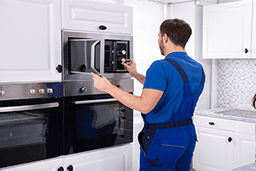
Our technicians repair solo, grill and convection microwaves from Samsung, IFB, Panasonic, Whirlpool, Godrej, Bajaj and Morphy Richards, including built-in models. AC Care India runs independently and holds no authorisation from any of these manufacturers; their names here only indicate what we repair. Ovens still under the brand's warranty should be taken to the brand's own service channel first.
Aizawl Neighbourhoods We Visit
Dawrpui, Bara Bazar, Chanmari, Zarkawt, Tuikual, Kulikawn, Khatla, Mission Vengthlang, Republic, Electric Veng, Chaltlang, Ramhlun North, Bawngkawn, Zemabawk, Durtlang, Luangmual, Vaivakawn, Thuampui, Edenthar, Falkawn and Dinthar.
Repair It or Buy a New One?
For an oven under six or seven years old, almost every fault short of a cracked cavity is worth repairing, including a magnetron replacement. For an older basic solo oven, a magnetron plus a control board can approach the price of a new unit, and we will tell you so honestly. Heavy rust that has eaten through the cavity wall, rather than surface rust on the paint, usually means replacement, since the cavity cannot be safely restored.
Get Your Microwave Looked At
AC Care India sends verified technicians, gives a written quote before any part is changed, covers both repairs and parts with a warranty, and offers same-day or next-day appointments in most parts of the city. Call 9266608882 or book online through this page with your locality, brand and the symptom you have seen. And if your oven has started to spark, stop using it until it has been checked.
