

Half Past Seven in Subhash Nagar, and the Microwave Just Went Quiet
Dinner is almost ready. Rotis are wrapped in a cloth, the dal needs reheating, and someone puts it in the microwave for two minutes. The lights flicker as half the street switches on fans and coolers at once, there is a soft click from the oven, and then nothing. The display is dark. The turntable has stopped. Pressing buttons does nothing. The next morning it is the same.
That scene, in one form or another, is behind a large share of the microwave calls we receive in Nizamabad. The cause might be a blown fuse, a failed door switch, a damaged board, or something more serious inside the high-voltage section. Before getting into what our microwave repair service in Nizamabad involves, it helps to understand what this town's climate, power and cooking habits do to these appliances.
Heat and Dust: A Hard Life for a Compact Appliance
A microwave oven is a tightly packed box. The magnetron, the part that actually generates microwaves, runs hot and relies on a small cooling fan pulling air through vents at the back and sides. In Nizamabad, kitchens regularly reach the high thirties between April and June, when outdoor temperatures sit in the mid-forties. That leaves very little headroom for cooling.
Many kitchens in the town's independent houses and older flats have the microwave on a narrow shelf or wedged between a wall and the fridge, with vents blocked. Dust blown in through open windows during the dry months settles on the fan and the vents. The result is a magnetron that runs hotter than it should, a thermal cut-out that trips mid-cycle, and eventually a magnetron that weakens and heats food unevenly.
Keep at least a few inches of open space behind and above the oven, and wipe the vents every few weeks during summer.
Storms, Voltage Swings and the Electronics Inside
From late May through September, thunderstorms roll across the Telangana plateau. Lightning strikes on lines, and the switching that follows a feeder trip, push brief surges through household wiring. Microwave control boards and touch panels are sensitive to these. So is the main fuse, which is designed to sacrifice itself.
Evening voltage dips are a separate problem. When supply drops well below normal, the high-voltage transformer delivers less power and food takes longer to heat. Some models show error codes or reset themselves. Older houses near the bazaar, where wiring is aged and sometimes lacks proper earthing, see this more.
A good-quality spike guard and, where voltage is consistently low in your lane, a small stabiliser for the kitchen circuit will protect the board. Unplugging the oven during a heavy storm is the cheapest protection of all.
How Local Cooking and the Monsoon Affect the Cavity
Telangana food is generous with oil, tamarind, chilli and ghee. Reheating curries and gravies without a cover splashes oil across the cavity walls and onto the waveguide cover, a small mica or card panel on the inner side wall. Grease soaked into that cover can char and spark. Over time, splashes also chip the cavity paint, and bare metal exposed to food acids starts to rust. Rust spots inside the cavity are one of the main sources of arcing.
The monsoon adds humidity. Steam from cooking condenses inside the oven when it is closed straight after use, and that moisture attacks the cavity and door hinges. Leaving the door open for a few minutes after cooking lets it dry out.
How Nizamabad Households Actually Use Their Ovens
In most homes here, the microwave is a reheating machine first: rice, curries, milk for children, leftover biryani from a function. Short, frequent bursts of two or three minutes are gentle on the magnetron. Families that bake cakes for birthdays or roast in convection mode put far longer loads on the heater, fan and door seals, and those parts wear sooner.
Two habits cause most avoidable damage. One is running the oven empty, often by a child pressing start by mistake, which reflects energy back into the magnetron and can burn it. The other is heating food in steel tiffin boxes or plates with gold or silver rims, which sparks instantly. Keep a microwave-safe glass bowl near the oven so nobody reaches for a steel katori in a hurry. A plain plate or a microwave-safe cover over curries also keeps the cavity far cleaner.
Shops, bakeries and canteens that run an oven all day should treat it like commercial equipment, with vent cleaning every week and a professional check every few months.
Symptoms and Their Usual Causes
| What you see or hear | Likely cause | Safe for you to check? |
|---|---|---|
| Completely dead, no display | Blown main fuse, failed door switch, surge-damaged board | Only check socket and plug |
| Light and turntable work, food stays cold | Magnetron, high-voltage diode or capacitor failure | No, high-voltage section |
| Sparks or blue flashes inside | Charred waveguide cover, chipped cavity paint, metal utensil | Remove metal and clean cavity only |
| Turntable not rotating | Turntable motor, coupler or roller ring | Check the roller ring is seated |
| Touch keys unresponsive | Membrane keypad worn or moisture-damaged | No |
| Loud humming or buzzing | Failing magnetron or transformer | No, stop using it |
| Convection mode not baking | Convection heater or fan | No |
| Stops mid-cycle | Thermal cut-out tripping from blocked vents or weak fan | Clear the vents |
What Happens During Our Service Visit
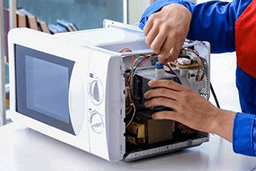
The technician first asks how the fault started, because "it stopped during a storm" and "it has been weakening for months" point in different directions. He then unplugs the oven and safely discharges the high-voltage capacitor before opening the cabinet. This step is non-negotiable; the capacitor can hold a lethal charge long after the plug is pulled.
Testing follows a fixed order: fuse, door interlock switches, thermal cut-outs, then the high-voltage diode, capacitor and transformer, and finally the magnetron's filament and insulation. On convection and grill models, the heater and fan are checked too. The cavity is inspected for paint damage and the waveguide cover for charring. Only after the fault is pinpointed do you get a quote. After repair, the oven heats a measured cup of water to confirm output, and a microwave leakage check is done around the door.
What You Can Safely Check Yourself, and What You Should Not
Fine to do yourself:
- Confirm the socket works with another appliance.
- Check that the roller ring and glass plate are seated properly.
- Wipe the cavity and remove any foil or metal-rimmed dishes.
- Clear dust from vents and give the oven room to breathe.
Leave to a technician:
- Anything that involves removing the outer cabinet.
- Replacing the fuse, which often blows because of another fault.
- Magnetron, diode, capacitor or transformer work.
- Door adjustment, since a misaligned door can leak microwave energy.
Brands We Service
Solo, grill and convection microwaves from Samsung, IFB, Panasonic, Whirlpool, Bajaj, Morphy Richards and Godrej, including built-in models.
Areas We Cover in Nizamabad
Subhash Nagar, Vinayak Nagar, Khaleelwadi, Pragathi Nagar, Kanteshwar, Nagaram, Gangasthan, Dharmapuri Hills, Anand Nagar, Lalbagh, Mirchi Compound, Tilak Garden, Gautam Nagar, Kota Galli, Police Line, Vengalarao Nagar, Mahalakshmi Nagar and the Armoor Road and Bodhan Road sides.
Should You Repair or Replace Your Microwave?
A fuse, door switch, turntable motor or diode is almost always worth repairing. A magnetron or control board replacement on a newer oven usually makes sense too. If the cavity is badly rusted through, or the oven is old and needs both a magnetron and a board, our technician will tell you plainly that a new one is better value.
A rough guide: most household microwaves give seven to ten years of service with sensible use. Under five years, almost any single fault is worth fixing. Between five and eight years, it depends on which part has gone and whether the cavity is still sound. Beyond that, a major high-voltage repair is a judgement call, and we will lay out both options so you can decide. One firm rule: a door that no longer closes squarely, or a cracked door glass, should never be ignored or taped over. The door and its interlock switches are what keep microwave energy inside the oven, and a damaged one must be repaired or the oven retired.
Book Microwave Repair in Nizamabad
AC Care India sends verified technicians, agrees the cost with you before opening any part for replacement, warranties its repairs and fitted parts, reaches most localities the same day or the next, and gives honest repair-or-replace advice. We are an independent multi-brand service, not an authorised centre for any manufacturer; brand names here only describe the ovens we repair, and an oven under its original warranty should go to the brand first.
Call or WhatsApp 9266608882, or book through this page.
