

A Rainy November Evening in Bhagya Nagar, and the Microwave Starts to Spark
It has rained since afternoon, the kind of steady Bay of Bengal rain that settles over Ongole in November. Power has gone twice and come back. In a second-floor flat, someone puts last night's pulihora into the microwave for two minutes. Thirty seconds in, there is a crackle, a blue flash on the side wall of the cavity, and a smell like a burnt matchstick. The oven is switched off in a hurry, and nobody wants to use it again until it has been looked at.
That is exactly the right reaction. Sparking inside a microwave is never something to ignore, and it is one of several faults that Ongole's climate and power conditions make more likely. This page explains how the city's weather, electricity and kitchens affect a microwave, what each symptom tends to mean, and what a microwave repair in Ongole from AC Care India involves.
Summer Kitchen Heat and a Microwave's Electronics
From March to May, Ongole's afternoons often run into the low forties, and kitchens in older houses, with a single small window and a gas stove going for lunch, get hotter still. A microwave oven is a box full of heat-generating parts: the magnetron, the high-voltage transformer, and in convection models a heating element and grill. All of them depend on a small cooling fan and enough space around the cabinet to stay within safe temperatures.
When the room is already hot and the oven is pushed into a tight niche or stacked on top of the fridge, which itself is releasing heat from its back, the internal temperature climbs. The thermal cut-out trips, so the oven stops mid-cycle and restarts later. Over time, the cooling fan bearings dry out, the magnetron weakens, and solder joints on the control board crack from repeated heating and cooling. Families notice it as an oven that "takes much longer than before" to heat a cup of milk.
Cyclone-Season Humidity, Storms and Voltage Swings
Ongole's heaviest rain arrives late in the year, with October typically the wettest month and cyclone warnings common through November and early December. Humidity climbs, and so does moisture inside appliances. A microwave's touch panel and control board are sensitive to damp; we see keypads that stop responding, buttons that press themselves, and displays that flicker during these months.
The storms also bring power cuts and lightning. A surge travelling down the line can blow the main fuse, damage the board, or kill the high-voltage diode. Ovens that were left plugged in during a storm night account for a good share of the calls we get in the weeks after a depression crosses the coast. Unplugging the oven, or using a spike-guard socket, is the simplest protection there is.
Dust, Coastal Air and the Way Kitchens Are Used Here
During the dry months, fine dust drifts indoors and collects in the oven's side vents and on the cooling fan. Closer to the coast, around the Kothapatnam Road side of town, metal surfaces corrode a little faster in the damp season, and that includes the oven's cavity paint and the hinges of the door.
Usage matters too. In many Ongole homes the microwave is mostly a reheating machine: rice, curries, milk, sambar, leftovers in steel tiffins that someone forgot to transfer. Spilled gravy and oil splash onto the waveguide cover, the small mica or composite sheet on the cavity wall. Once that cover is soaked with food grease, it carbonises and sparks. That is precisely what happened in the Bhagya Nagar flat above.
Microwave Symptoms and What They Usually Point To
| What you see | Most likely cause | Safe for you to check? |
|---|---|---|
| Sparks or blue flashes inside | Greasy or burnt waveguide cover, damaged cavity paint, metal in the dish | Remove metal; the rest needs a technician |
| Runs, light on, turntable turns, food stays cold | Failed magnetron, high-voltage diode or capacitor | No, high-voltage circuit |
| Completely dead, no display | Blown main fuse, door switch fault, board damage after a surge | Check socket and plug only |
| Turntable not rotating | Worn coupler, failed turntable motor, misplaced roller ring | Yes, reseat plate and ring |
| Keys not responding | Moisture in touch membrane, failed keypad ribbon | No, panel needs opening |
| Stops mid-cycle | Thermal cut-out tripping, blocked vents, weak cooling fan | Yes, clear space around the oven |
| Convection mode not baking | Burnt heater element or convection fan motor | No |
What Happens During Our Repair Visit
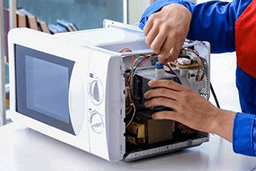
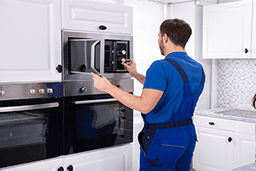
When our technician arrives, the first job is to ask how the fault started and to look at the oven running if it is safe to do so. Before any panel comes off, the oven is unplugged and the high-voltage capacitor is safely discharged. This capacitor can hold a dangerous charge long after the plug is pulled, which is the main reason microwave repair is not a home job.
Next, the technician tests the door interlock switches, the main fuse, the transformer, the diode and the capacitor with a meter. The magnetron is checked for continuity and insulation. The cooling fan and turntable motor are run, and the control board is inspected for burnt tracks or swollen components. In the cavity, we check the waveguide cover and paint for burn marks.
Once the fault is clear, you get the quote. After the repair, we test with a cup of water, timing how quickly it heats, and we do a microwave leakage check around the door seal. You also get advice on placement and cleaning so the same fault does not come back.
What You Can Safely Check, and When to Stop
- Plug the oven into a different socket that you know works, ideally without an extension board.
- Make sure the door closes with a firm click. A door that does not latch keeps the oven off by design.
- Remove the glass plate and roller ring, clean them, and reseat them on the coupler.
- Wipe the cavity and the waveguide cover with a damp cloth when the oven is cold and unplugged.
- Leave at least a hand's width of space at the back, sides and top for ventilation.
- Stop if you smell burning, see scorch marks, or the oven hums loudly without heating. Do not open the outer casing.
Microwave Brands We Repair
Our technicians work on solo, grill and convection ovens from Samsung, IFB, Panasonic, Whirlpool, Godrej, Bajaj and Morphy Richards, including OTG-style combination units.
AC Care India is not an authorised service centre for any of these companies. We are an independent multi-brand repair service, and the brand names here simply identify the products we handle. An oven still under its maker's warranty should go to the brand first.
Ongole Localities We Reach
Gandhi Nagar, Lawyerpet, Bhagya Nagar, Ram Nagar, Trunk Road, Kurnool Road, Santhapet, Islampet, Mangamuru Road, Kothapatnam Road, Sujatha Nagar, Venkateswara Colony, Balaji Nagar, Gaddalagunta, the RIMS area, Old Town, Throvagunta, Pellur, Vengamukkapalem and Mukthinuthalapadu.
Repair or Replace: An Honest View
Most microwave faults are worth repairing. Fuses, door switches, turntable motors, keypads, diodes and capacitors are modest parts, and a waveguide cover costs little. The decision gets harder when the magnetron or the main board fails on an oven that is eight or ten years old, or when the cavity paint has rusted through and keeps sparking. In those cases, a new oven may be the better spend, and we will tell you so. We would rather lose a repair than fit an expensive part into an oven that will not last.
If you do replace, a few choices make a difference in Ongole homes. A solo oven is enough if you mainly reheat and defrost. A convection model earns its place only if someone in the family actually bakes cakes or roasts; otherwise its heater and fan are just more parts to fail. Look for a model with a steel or ceramic-enamel cavity that is easy to wipe, because reheated gravies and pickles splash. And plan the spot before the oven arrives: a dedicated earthed socket, a counter away from the stove's direct heat, and open space for the vents.
Small habits that prevent most repeat calls
Cover dishes with a microwave-safe lid so curry does not spray the waveguide cover. Never run the oven empty, because the magnetron's energy has nothing to absorb it. Transfer food out of steel tiffins and foil before heating. Wipe the door seal weekly. Unplug the oven when a storm and repeated power cuts begin, especially in the October to December cyclone weeks. These are simple steps, yet they account for most of the difference between an oven that lasts four years and one that lasts ten.
Book Microwave Repair in Ongole
When you book with us, you get a verified technician, a quote given before any work starts, original or compatible spares, a warranty on the repair, and a same-day or next-day visit across most of Ongole. Call 9266608882 or book online through this page, and tell us the model and what the oven is doing.
