

Sri Ganganagar's Heat, Dust and Power Swings, and What They Mean for a Microwave
Sri Ganganagar lives through some of the hottest summers anywhere in India, with average highs around 42°C in May and June and record days near 49°C. The same city sees winter nights at freezing point, sand-laden dust storms before the monsoon, and voltage that rises and falls with the load of farms, shops and homes on the same lines. A microwave oven sits right in the middle of all this, usually on a crowded kitchen counter next to the gas stove. Its electronics, its high-voltage parts and its cooling fan feel every one of those conditions.
This page explains how the local climate and power supply affect a microwave, how to tell what is wrong, and what to expect when AC Care India carries out microwave repair service in Sri Ganganagar.
A Hot Kitchen Is a Hard Place for Electronics
A microwave produces a lot of heat inside its casing. The magnetron, which generates the microwaves, and the high-voltage transformer both rely on a small cooling fan pulling air through vents at the back and sides. When the kitchen itself is at 40°C on a June afternoon, that fan is only moving hot air over hot parts. Push the oven tight against a wall or box it into a cabinet, and the vents cannot breathe at all.
The result is a thermal cut-out that trips mid-cycle, a magnetron that weakens with each overheating episode, and a control board whose capacitors dry out early. Many of the "it heats for a minute and then stops" calls we get in summer are heat protection doing its job, and the fix starts with moving the oven to a spot with space around it.
Dust Storms, Grease and the Inside of Your Oven
From April to June, fine sand blows into every kitchen in the city, through window gaps and on clothes. It settles on the oven's vents, gets pulled in by the fan, and mixes with the grease that inevitably builds up from heating parathas, sabzi and milk. That sticky layer coats the fan blades and the high-voltage section. Over time it can cause tracking and arcing across components, and it makes the fan motor work harder. A microwave kept near the tawa where rotis are made twice a day collects grease fastest.
Inside the cavity, food splashes left to bake on cause the paint to blister. Once bare metal shows, sparks follow. The thin mica waveguide cover on the side wall soaks up grease and eventually burns, which is the source of many sudden flashes and burning smells.
Voltage, Surges and the Control Board
Microwaves draw a heavy current the moment the magnetron fires. On a weak line, especially during evening peaks, the voltage dips, and when power comes back after a cut it can spike. Storms in the short monsoon season add lightning surges. These events kill the main fuse, the PCB relays, the touch panel and, sometimes, the high-voltage diode. A basic spike guard on the oven's socket and a proper earth connection prevent a surprising number of these failures.
Winter use and condensation
In December and January, when Sri Ganganagar mornings sit near freezing, the microwave gets used far more for warming milk, reheating dal and defrosting. A cold oven heating watery food produces a lot of steam, and in an unheated kitchen that steam condenses inside the door, on the cavity walls and around the vents. Over a few winters this moisture rusts the cavity seams and the door frame and affects the touch panel. Wiping the cavity dry after use and leaving the door open for a few minutes is a simple habit that prevents much of it.
How households here use their ovens
In most homes the microwave is a reheating and defrosting machine first. Convection models are used for cakes and baking around birthdays, Diwali and Christmas, and grill mode for tikka and toast. Heavy convection use over a festive week puts sustained heat on the heater, the convection fan and their relays, and that is when we see a burst of calls about grill or convection mode not working while plain microwave mode is fine.
Symptoms and What They Usually Mean
| What You Notice | Most Likely Fault | Safe to Check Yourself? |
|---|---|---|
| Oven runs, light and turntable work, food stays cold | Magnetron, high-voltage diode or capacitor | No. High-voltage parts |
| Completely dead, no display | Blown main fuse, door switch, PCB failure after a surge | Only check the socket and plug |
| Sparks inside the cavity | Burnt waveguide cover, peeling cavity paint, metal object inside | Remove metal; stop using if it continues |
| Turntable not rotating | Turntable motor or coupler worn, roller ring dirty | Yes, clean and reseat the ring |
| Stops partway through cycle | Overheating, blocked vents, faulty thermal cut-out or fan | Yes, clear space around vents |
| Some touch keys do not respond | Membrane keypad worn or damp, PCB fault | No |
| Convection or grill mode not heating | Heater element, convection fan or relay failure | No |
| Loud humming and burning smell | Failing magnetron or transformer | No. Switch off and unplug |
What Happens During a Service Visit
When our technician arrives, he first asks how you use the oven, whether for reheating, baking cakes for birthdays, or grilling paneer tikka, because each mode stresses different parts. He then checks the socket voltage and earth, inspects the door, hinges and latch, and runs a short test with a cup of water to measure whether heating is happening at all.
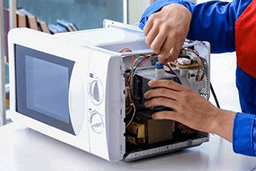
Next, with the oven unplugged, he opens the casing and discharges the high-voltage capacitor safely. Only then are the fuse, door interlock switches, magnetron, diode, capacitor and transformer tested with the right meter. The cavity, waveguide cover, fan and vents are inspected for grease, sand and burn marks. You are given a clear explanation of the fault and the cost before any part is replaced. After repair, the oven is reassembled, tested in every mode it has, and checked for microwave leakage around the door.
Leave It, or Call a Technician?
Things you can check safely
- Is the plug fully in and the socket working? Test with another appliance.
- Is the door closing firmly? A bent latch stops the oven from starting.
- Is the glass tray seated on the coupler and the roller ring clean?
- Is there at least a few inches of space around the vents?
- Are there any metal-trimmed plates, foil or steel spoons inside?
When to stop and call
- Any sparking that continues after removing metal objects.
- Food not heating even though everything else seems to work.
- A burning smell, smoke or loud buzzing.
- A cracked door glass or a door that does not seal.
- Repeated fuse failures.
Never open the casing yourself. The high-voltage capacitor can hold a dangerous charge long after the oven is unplugged.
Microwave Brands We Repair
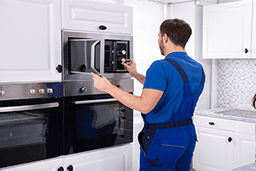
Solo, grill and convection models from Samsung, IFB, Panasonic, Whirlpool, Godrej, Bajaj and Morphy Richards, including built-in units in modular kitchens. AC Care India is an independent multi-brand appliance repair service, not the authorised service centre of any of these makers; their names are used here only to describe the ovens we work on. If your microwave is still under the maker's warranty, the brand should be your first call.
Small Habits That Extend a Microwave's Life Here
- Cover food with a microwave-safe lid so splashes do not bake onto the cavity walls.
- Wipe the waveguide cover gently each week; do not scrub it with steel wool.
- Keep the oven away from the tawa and gas burners, with open space at the back.
- Plug it into its own earthed socket with a spike guard, not a shared multi-plug.
Where Our Technicians Go
We cover Ravindra Path, Gol Bazar, Purani Abadi, Jawahar Nagar, Sukhadia Nagar, Agrasen Nagar, Vinoba Basti, Housing Board Colony, Mukherjee Nagar, Indira Colony, Old Dhan Mandi, Bhagat Singh Chowk, Meera Chowk, Gaushala Road, Suratgarh Road, Hanumangarh Road, Padampur Road and the city's residential blocks including E Block, L Block and Q Block.
Is It Worth Repairing?
Fuses, door switches, turntable motors, waveguide covers, fans and many PCB faults are inexpensive to fix compared to a new oven, and well worth it. A magnetron or transformer replacement on an older solo microwave can come close to the price of a new basic model, and a rusted-through cavity is usually the end of the road. Our technicians are verified, quote upfront, use genuine or reliable compatible parts with a warranty, and in most areas visit the same day or the next. They will tell you plainly which side of that line your oven falls on.
Book Microwave Repair in Sri Ganganagar
Call or WhatsApp 9266608882, or book online through this page. Share the brand, whether it is solo, grill or convection, and what is happening, and we will send a technician with the right parts.
