

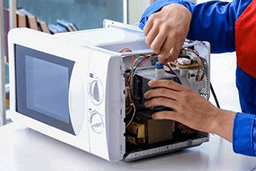


A Hot, Salty, Humid Coast Is Hard on Microwave Ovens
Thoothukudi sits on the Gulf of Mannar with warm weather for twelve months, humidity that rarely lets up, and a rainy season concentrated into a few heavy weeks between October and December. For a microwave oven, that combination means three things. Moisture and salt work their way into door switches, connectors and the control board. Steam from cooking condenses inside the cavity and lifts the paint, which leads to sparking. And storm surges on the supply line test the high-voltage section and the touch panel.
None of this means a microwave here is doomed to fail early. It means the faults follow the calendar quite closely, and knowing what to watch for in each season makes a real difference. Below is how the year plays out for microwave repair service in Thoothukudi, followed by a fault table, our service checklist and a frank list of what we will not do.
January and February: Pongal Cooking and a Good Time for a Check-Up
The coolest stretch of the year is still warm, but the air is a little drier. It is also festival time, with Pongal cooking and relatives visiting. Microwaves get used for reheating large batches, and turntables carrying heavy dishes start to wobble or stop. A stalled turntable usually means a worn coupler or a failed turntable motor, both simple fixes. This is the ideal window to get an older oven inspected before summer, because cavity and door issues are easier to address before the heavy humidity returns.
March to June: The Long Hot Season
Kitchens get very hot. A microwave tucked in a corner next to the gas stove, or built into a cabinet without ventilation space, runs its cooling fan constantly and the magnetron runs warmer than it should. Overheating shows up as the oven switching off mid-cycle, a burning smell, or heating that becomes weak and uneven. The thermal cut-out may be tripping, or the magnetron may be wearing out. Keep at least a few inches of clear space around vents, and clean grease off the vent grilles so the fan can breathe.
Convection models used for baking, popular for cakes and the cashew-rich macaroons the city is known for, see heavier loads on their heating element and convection fan during these months.
July to September: Windy, Dusty Spells
The southwest monsoon brings little rain here, but it brings wind. Dust from open ground, the salt pans and the port area blows into homes, settling on vents and inside cooling ducts. In August, the Our Lady of Snows festival draws crowds to the city, and many households cook for guests. Microwaves with clogged vents run hot, and dust on the control board can cause erratic touch-panel behaviour. A gentle vent clean, done with the oven unplugged, helps a lot.
October to December: Northeast Monsoon and Storm Surges
Most of Thoothukudi's annual rain arrives in this period, often with lightning. This is when we see the most dead microwaves: blown main fuses, failed high-voltage diodes, damaged transformers and touch panels that stopped responding after a storm. Humidity peaks, and condensation inside the cavity attacks the paint near the waveguide cover. Peeling paint or a damaged waveguide cover causes sparking and blue flashes. Diwali and Christmas cooking fall in the same months, so a fault that was minor in September can become a big one.
Use a surge protector or switch the microwave off at the socket during heavy thunderstorms. If your home was affected by flooding, do not plug in a microwave that took in water until a technician has checked it.
Year-Round Habits That Protect the Oven
Whatever the month, a few daily habits do more for a microwave's life than any repair. Wipe the inside of the cavity after cooking anything that splatters, especially curries with oil and masala, because food residue absorbs energy, chars and damages the paint and waveguide cover. Leave the door open for a minute after use so trapped steam can escape instead of condensing inside; in a coastal kitchen, this one habit noticeably reduces rust inside the cavity.
Never run the oven empty. Without food or water to absorb microwaves, the energy reflects back to the magnetron and shortens its life. Use only microwave-safe containers. Steel tiffin boxes, foil and plates with metallic rims cause arcing. Avoid placing the microwave directly on top of the fridge, where the fridge's warm exhaust and the microwave's vents fight each other.
Finally, do not ignore a door that does not close with a firm click. The door switches and latch are what stop microwave energy from escaping. A sagging hinge, a broken hook or a cracked door frame needs attention, not tape. In homes with children, a door problem is the first thing we fix.
Fault, Cause and Fix at a Glance
| Fault | Common Cause | What We Do |
|---|---|---|
| Runs, light on, food not heating | Weak magnetron, failed HV diode or capacitor | Discharge and test HV section; replace failed part |
| Sparking or blue flashes inside | Damaged waveguide cover, peeling cavity paint, metal utensil | Replace cover, treat cavity with microwave-safe paint |
| Completely dead | Blown fuse from surge, door switch failure | Test fuse and interlocks; find root cause before replacing |
| Turntable not rotating | Broken coupler, failed turntable motor | Replace coupler or motor |
| Buttons not responding | Moisture on touch membrane or control board | Clean, dry and test; replace panel if damaged |
| Stops mid-cycle | Thermal cut-out tripping, blocked vents, loose door latch | Clean vents, test thermostat, adjust latch |
| Convection not browning | Heater element or convection fan failure | Test element resistance and fan motor |
Our 10-Step Service Checklist
- Check the socket voltage and earth connection.
- Safely discharge the high-voltage capacitor before opening the casing.
- Inspect and test the door interlock switches, which are critical for safety.
- Test the magnetron, HV diode, capacitor and transformer.
- Check the waveguide cover and cavity paint for damage or burn marks.
- Test the turntable motor and coupler.
- Clean and test the cooling fan and vents.
- Inspect the control board and touch panel for moisture or corrosion.
- For convection models, test heater element and convection fan.
- Run a water-heating test and check for microwave leakage around the door.
What We Will Not Do
- We will not tell you to repair a microwave with a rusted-through cavity. Once the cavity wall is perforated, it is unsafe and not repairable.
- We will not bypass a door interlock switch to get an oven working. That is a serious safety risk.
- We will not replace a magnetron without testing the HV diode and capacitor, because a bad diode can kill a new magnetron.
- We will not suggest DIY high-voltage repairs. The capacitor can hold a dangerous charge even after unplugging.
- We will not quote over the phone for a fault we have not seen.
We are also honest about cost-benefit. A basic solo microwave that needs a new magnetron plus a control board after many years of use may cost close to a new unit to repair. In that case we show you the numbers and let you choose. A convection or built-in model, on the other hand, is usually well worth repairing because replacement is expensive and most of its parts are serviceable. For a microwave that has taken in floodwater, we test insulation resistance before anything is powered on, and we will advise against using it if the cavity or board has been compromised.
Where We Work in Thoothukudi
Our technicians visit Anna Nagar, Millerpuram, Bryant Nagar, Muthammal Colony, Polepettai, Caldwell Colony, Tooveypuram, Boltenpuram, KTC Nagar, Meenakshipuram, Threspuram, Lourdammalpuram, Sivanthakulam, Rahmathullapuram, Mappillaiurani, Inigo Nagar, Thiruvika Nagar and Muthu Nagar.
Brands We Repair
Solo, grill and convection microwaves from Samsung, IFB, Panasonic, Whirlpool, Godrej, Bajaj and Morphy Richards, including built-in and countertop models. Our technicians also look after older ovens that are no longer sold, as long as safe parts can still be sourced for them, and we tell you upfront if a particular board or magnetron is hard to find.
Why Choose AC Care India
Every technician is verified and trained on high-voltage safety. You get the quote first, the work second. Repairs and fitted parts carry a warranty. Spares are genuine or trusted compatible items, clearly identified. Visits are usually same day or next day in most areas. And if an oven is not worth fixing, we tell you directly. AC Care India is an independent service provider covering many brands; we are not the authorised service centre for any manufacturer, and brand names on this page only indicate products we service. For in-warranty units, please contact the brand first.
Book Microwave Repair in Thoothukudi
Call or WhatsApp 9266608882, or book through this page with your area, the brand and what the oven is doing. Our technician will bring the most likely parts and test thoroughly before quoting.
