

A Hot May Afternoon in Jawahar Nagar, and the Purifier Light Will Not Turn Blue
It is close to four in the afternoon. A dry wind is coming in off the fields beyond Lingasugur Road, the sky has that pale, dusty look Raichur gets before the rains, and a fine brown film has settled on the window sill again. Inside, the air purifier in the bedroom is roaring on its highest speed, but the quality ring stays orange. The owner has already pressed the filter reset twice. Nothing has changed.
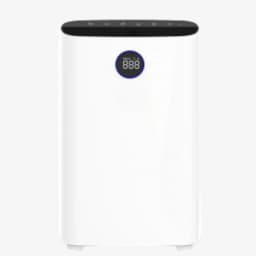
This is the kind of call we get often. Sometimes the purifier is genuinely faulty. More often, one specific part has quietly reached the end of its life under Raichur's dust load, and the machine is doing exactly what it was designed to do with a filter that can no longer cope. To understand which, it helps to know what is inside the box. This page takes an air purifier apart, piece by piece, and explains what tends to fail in each part in this city, how we test it, and when air purifier repair in Raichur is worth it.
What Raichur's Air Asks of a Purifier
Raichur does not suffer the thick winter smog of the Indo-Gangetic plains, and it is honest to say that on many days the air here is fair. The challenge is different. It is a dust city. The black cotton soil of the surrounding farmland dries out through the long summer and lifts into the air with every gust. Highways, trucks hauling cotton and grain, and constant construction add to it. In the ginning season, lint drifts from the mills and markets around Gunj Road.
Then there is the industrial side. The Raichur Thermal Power Station at Shaktinagar and the Yermarus plant to the north mean that homes in those directions sometimes report a grey, powdery deposit that is finer than ordinary soil dust. Add festival crackers around Diwali, the odd stubble or garbage fire on the city's edge, and a humid, mould-prone monsoon, and a purifier here faces a heavy load of coarse particles for most of the year, with fine-particle spikes on top.
Coarse dust is the part many people overlook. It does not always show up dramatically on an AQI app, yet it is exactly what fills a pre-filter and the outer face of a HEPA sheet fastest.
Inside the Machine: Each Part and How It Fails Here
The pre-filter
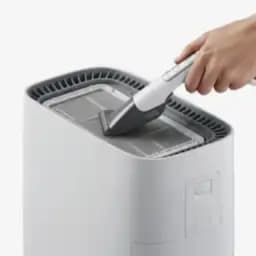
This is the coarse mesh or foam layer at the front. Its job is to catch hair, lint and visible dust before they reach the expensive filter behind it. In Raichur homes, especially near main roads or the market, it can be matted within a fortnight in summer. A blocked pre-filter starves the fan of air, so the machine gets noisy while moving very little.
The HEPA filter
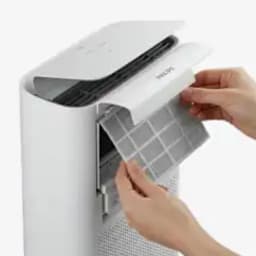
The pleated white sheet is the heart of the purifier. True HEPA media traps very fine particles in a dense web of fibres. It cannot be washed; water collapses the fibres and ruins it. Under heavy dust, the pleats fill from the front, airflow drops, and the machine compensates by running its fan harder. Brand guidelines often suggest yearly replacement, but here filter life can be noticeably shorter in a dusty location.
The activated carbon layer
Carbon granules or a carbon-coated sheet absorb odours, cooking smells and some gases. Once its pores are full, it stops working, often well before the HEPA layer looks dirty. If the purifier clears dust but the room still smells of smoke or tadka, the carbon is usually exhausted. In the humid monsoon weeks, a saturated carbon layer can also start to smell musty itself.
The fan and motor
Most home purifiers use a brushless DC motor driving a centrifugal fan. They are reliable, but they dislike two things that Raichur supplies in plenty: heat and dust. A fan forced to pull through a choked filter for months runs hot. Dust that gets past a torn seal coats the impeller and unbalances it, causing a rattle or hum. In rooms that reach the high thirties in May, the motor control electronics run near their limits.
The particle sensor
The number or colour ring comes from a small optical sensor, usually an infrared or laser unit that counts particles in a sample of air passing through a narrow window. Fine dust and lint settle on that window, and the sensor then reads permanently "poor". This is one of the commonest reasons a perfectly working purifier appears faulty. Some models also have a gas or VOC sensor that drifts with age and humidity.
The ioniser, UV lamp and control board
Some machines include an ioniser or UV-C lamp. Ionisers can fail silently; UV lamps age and dim. The control PCB handles the touch panel, Wi-Fi, timers and fan speed. In the pre-monsoon storm season, voltage surges through overhead lines can damage its power section or the adapter. A dead display after a stormy night usually points here.
How We Find the Real Fault
Pressing "reset" and swapping a filter is not diagnosis. When our technician visits, the checks run in a fixed order so that nothing expensive is replaced on a guess:
- Note the model, filter type, room size and where the unit is placed.
- Inspect the pre-filter, HEPA and carbon layers against light to judge loading.
- Check the filter seal and housing for gaps that let dust bypass the filter.
- Measure airflow at each fan speed and listen for bearing noise or imbalance.
- Clean the particle sensor window and lens, then compare its reading with a reference meter.
- Test the adapter or internal power supply output and look for surge damage.
- Check the touch panel, display and app connectivity on smart models.
- Confirm the filter-life counter has been reset correctly for the brand.
- Explain the findings and quote before any part is fitted.
In practice, a good share of visits end at step five or six, with a cleaned sensor, a new pre-filter or a corrected reset rather than a costly board change.
Part Life, Raichur Edition
| Part | How long it tends to last here | Warning sign |
|---|---|---|
| Pre-filter | Cleaning every 1 to 2 weeks in summer; replace when torn or stiff | Fan loud but weak airflow |
| HEPA filter | Often shorter than the brand's rated life in dusty homes | Grey pleats, slow clearing, constant high speed |
| Carbon layer | Often exhausted before the HEPA sheet | Smells linger; musty odour in monsoon |
| Particle sensor | Years, if its window is cleaned | Reading stuck on poor or jumping wildly |
| Fan motor | Many years with clean filters | Hum, rattle, burning smell, speed not changing |
| UV lamp | Ages with use; check manual | Indicator off, lamp not glowing |
| Adapter / PCB | Long, unless hit by a surge | Dead display, random restarts after storms |
"It's Broken" or "It Needs a Filter"? A Quick Check
Before you book a visit, try this. Switch the purifier off and unplug it. Remove the pre-filter and wash it if the manual allows, then let it dry fully. Hold the HEPA filter up to a window; if light barely comes through, it is due. Wipe the sensor opening, usually a small grille on the side, with a dry cotton bud. Put everything back and run it for fifteen minutes on medium.
If the reading improves and airflow feels stronger, you have saved a call. If the machine is still loud and weak, shows an error, smells of burning, or does not power on at all, that is a job for a technician.
Room size matters too
A compact purifier rated for a small bedroom cannot clean an open hall-and-dining space in a Raichur bungalow. It will run flat out, wear its filter quickly and still struggle. If that is the real problem, we will say so rather than sell you a part.
Installation, Relocation and Yearly Care
We help with more than repairs. When you buy a new purifier, our technician can advise on placement: away from the wall by the distance the manual recommends, not wedged behind a curtain, and not directly under the AC's airflow. If you are shifting house within Raichur, we can check the machine after the move, since filters often unseat in transit.
For households with several units, or for clinics, offices and schools, a yearly care plan covers scheduled filter checks, sensor cleaning and a pre-summer inspection. In this city, the best time for that inspection is late February, before the dust and heat peak, with a second look after Diwali.
Purifier Brands Our Technicians Handle
We work on Honeywell, Philips, Sharp, Coway, Mi and Xiaomi, Kent, Blue Star, Havells, Eureka Forbes and Dyson models, including tower, tabletop, room and smart Wi-Fi units. Where a genuine filter is hard to find locally, we explain the options and let you choose.
AC Care India is an independent repair service working on many brands. We are not the authorised service centre of any purifier maker, and brand names here only describe the machines we service. If your unit is still under the manufacturer's warranty, please contact the brand first.
Neighbourhoods We Cover in Raichur
Our technicians visit Jawahar Nagar, IDSMT Layout, Station Road, Shaktinagar, Nijalingappa Colony, Bapuji Nagar, Mangalwarpet, Vidya Nagar, Siyatalab, Gunj Road, Basaveshwar Nagar, Tilak Nagar, LBS Nagar, Hyderabad Road, Ashapur Road, Gadwal Road, Lingasugur Road, Mantralayam Road and Yermarus, along with nearby colonies.
Why People in Raichur Call Us, and How to Book
- Background-checked, trained technicians who know purifier internals.
- A clear quote before any part is changed.
- Warranty on the repair work and on parts we fit.
- Genuine or properly compatible filters and spares.
- Visits the same day or the next day across most of the city.
- Straight advice when a new purifier is a better buy than a repair.
Call or WhatsApp 9266608882, or book online through this page. Tell us your locality, the brand and model, and what the purifier is doing, and we will schedule a visit for air purifier repair in Raichur at a time that suits you.
