

Guide to Selecting the Best Local RO Service Provider
Introduction
Safe drinking water is something you only notice when it stops being safe. A strange taste a bad smell or a slow trickle from your RO unit is the usual warning that maintenance is late. Many people type “ro services near me” and call the first number that appears. That hurry is natural, but it often ends in sloppy work, parts changed for no reason and breakdowns that return within weeks.
A good RO unit is a long term purchase - a good technician is the same. The wrong worker can tear the membrane, fit fake filters or skip vital checks. Over time the machine fails plus the family drinks water that is no longer safe. On that account picking the best local RO service provider needs the same care you used to pick the purifier.
Your neighbourhood probably has multiple repairers and small firms that claim to know every brand. A few are authorised partners, a few are independent multi brand specialists and a few are untrained helpers who learn while they work. Without clear rules it is hard to decide whom to trust.
This guide shows you, step by step, how to judge local experts, what questions to ask before you book, how to check the quality of the work but also how to set up a long term service link that keeps the RO running without surprises.
Key factors to evaluate before choosing a provider
1. Training and technical skill
When you draw up a shortlist of RO service firms, find out what training the technicians hold. Ask the following
Did they receive factory instruction on brands like Kent, Pureit, Aquaguard, Livpure, AO Smith, Blue Star or Hindware?
Do they know how RO, UV, UF, TDS control and mineraliser systems work?
Are they able to name the filtration stages used in your exact model?
Technicians who carry brand approval or formal training tend to diagnose faults correctly as well as to replace filters and membranes at the right intervals. They also bring proper tools and follow safety steps.
Experience with your water conditions
Reverse-osmosis units react to local water. A technician who has served your area for years knows the groundwater or the municipal supply. That means the technician recognises high TDS, hard water, iron or repeated bacterial events.
Ask
How many years have you worked inside this locality?
Do you change service advice when TDS or consumption rises or falls?
Name one nearby installation you still maintain that matches my situation.
Years of local work usually lead to correct choice of pre filter, carbon stage and membrane guard - those choices extend purifier life and hold down running cost.
Transparency in pricing plus parts
Hidden fees and needless replacements are the most frequent complaints. To stay in front of the problem
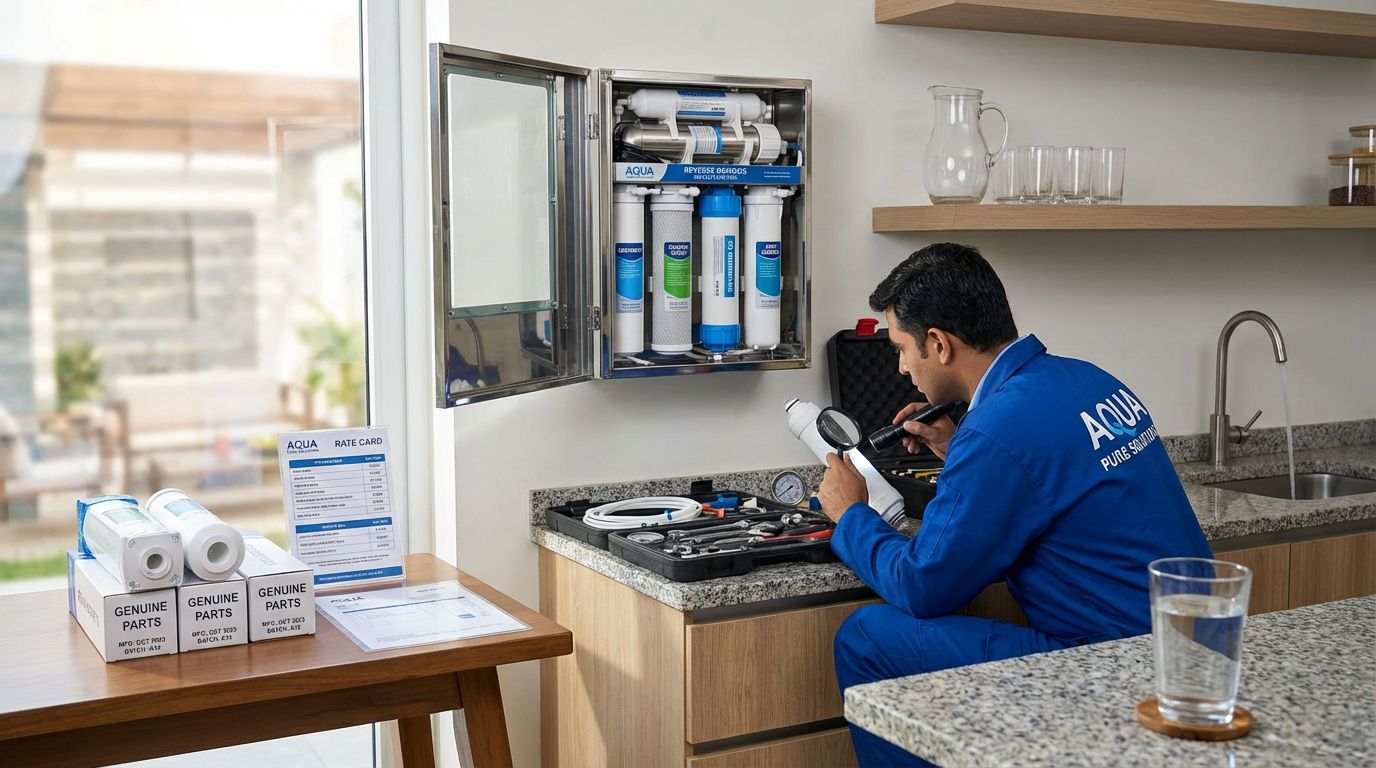
Demand a printed rate card that lists the price of a service visit, every filter change, every membrane swap plus extra tasks like installation or reinstallation.
Ask if the inspection fee is subtracted from the final bill when you approve the repair.
Tell the technician to hand over the old filters and membranes that were removed.
Require a bill that names each replaced part, states the brand but also states the warranty period.
A provider who states prices openly and explains every line is normally more reliable.
Quality as well as authenticity of spare parts
The output of the RO rests on the grade of consumables. Counterfeit or low grade cartridges cost less - yet they block early and can release pollutants back into the water.
Check
That the cartridges are original or match your model.
That the wrapper carries the brand logo, batch code, date of manufacture and expiry date.
That the company gives at least a short warranty or service promise on major items like the membrane also the pump.
Service responsiveness and turnaround time
When the unit fails you need help the same day. Compare firms on
The minutes or hours that pass between your call next to their reply.
Whether they arrive the same day or the next day.
The hours they keep including Saturdays, Sundays and public holidays.
Whether an emergency visit exists for large leaks or total stoppage.
Speed matters - yet it must not end in a rushed or unfinished repair.
6. References plus reputation
Collect real comments from neighbours.
Read Google ratings and other online posts.
Ask neighbours the housing society office or local online groups for names they trust.
Look for praise about arrival time, courtesy, clarity but also help after the job, not only about technical skill.
A name that stays good year after year usually signals steady service.
Types of RO service providers you will meet
Authorised brand service centres
Those centres report straight to the maker - Kent, Pureit, Aquaguard, Livpure, AO Smith or any similar brand.
Advantages
Technicians receive factory training on the exact model you own.
They fit only original spare parts, load the latest firmware and give official support.
Work keeps the product warranty valid.
Drawbacks
Labour plus parts cost more than local rates.
Booking a slot can take longer, mainly in peak seasons.
Each centre handles only its own brand - it will not touch other brands in the same house.
Independent multi brand specialists
Those are local or regional firms that repair many brands and models under one roof.
Advantages
They offer wider time slots but also usually arrive faster.
A single agency services every purifier in your flat or housing society.
Prices stay competitive and annual maintenance contracts fit your exact need.
Drawbacks
Skill levels differ sharply - you must check background as well as reviews.
If you do not watch, you may receive duplicate or ill fitting spare parts.
Individual freelancers or small neighbourhood technicians
Those are self employed repairmen who live nearby and rely on word-of-mouth.
Advantages
You reach them quickly if they already know your area.
You bargain the price face to face.
Drawbacks
If the job fails you have little recourse.
No formal complaint channel or escalation path exists.
They keep only a narrow stock of spare parts.
Where RO Care India or Doctor Fresh stand
As Indian homes fit RO systems from multiple brands, organised service networks turn essential. RO Care India is a platform devoted to RO and water-purifier upkeep across brands. It links you to trained technicians, sells structured service plans also keeps tighter control over process, parts and price than unorganised local repairers.
Doctor Fresh designs next to sells its own purifiers plus water treatment gear and it stresses prompt, expert after sales help. Because the same company makes the unit plus services it - its teams grasp the full life cycle - installation, routine care and later upgrades. They pick the right filter set but also service gap - looking at real use and local water quality.
Many familiar brands - Kent, Aquaguard, Livpure, Pureit, AO Smith, Blue Star, Hindware, Aquafresh, Nasaka - run their own service centres or use authorised partners. If your purifier is still under the standard or extended warranty, use those official channels - that action keeps the warranty valid. For out-of-warranty units or for homes that use multiple brands, independent networks that enforce strict quality checks often cost less and are easier to arrange.
What to check while the technician is on site plus after the visit
When the technician arrives, carry out those quick checks to judge competence
The person first examines the entire purifier then declares which parts have failed.
The person measures the TDS of the raw water and of the treated water but also tells you what the numbers mean.
The person hands you the old filter or membrane that was removed and explains why it had to be changed.
The person verifies that no leaks exist, that water pressure is correct, that the pump sounds normal as well as that the storage tank is clean.
The person opens the sediment and carbon housings and scrubs them - the person does not simply drop in new cartridges.
After the work is finished
Flush the tank once then taste or smell the water.
For two days watch the flow rate and listen for unusual noise.
Inspect all joints also the tank for signs of leakage.
File the invoice and the list of parts that were replaced.
If the same fault returns soon, a trustworthy provider will come back, inspect the unit again next to fix the fault at no extra cost.
Choosing the service model - pay-per-visit or Annual Maintenance Contract
You may call a technician only when a fault appears or you may sign an Annual Maintenance Contract (AMC).
Pay-per-visit suits new purifiers that fail rarely - you pay for each visit or for each part that is replaced.
An AMC suits old purifiers or units that treat very poor water - the contract normally covers two to four scheduled services, all required filters and emergency breakdown support. The contract keeps the yearly spend predictable plus prevents sudden large repair bills.
Before you sign check which filters the AMC includes, how many preventive visits it offers, how fast the company promises to arrive and whether the membrane or the motor is covered.
Conclusion
Picking the best RO service provider in your area is not a race to find the fastest or the cheapest. The goal is to keep the water pure at all times, to extend the life of the purifier but also to avoid repeated failures. Judge each provider on staff training, familiarity with your brand, knowledge of local water, clear pricing, quality of spare parts, speed of response and past reputation.
Compare three kinds of help - the maker's own service centre, a country wide network like RO Care India or Doctor Fresh and a neighbourhood repair shop. Decide - looking at how old the purifier is, whether it is still under warranty plus what your household needs. Each time a technician comes, watch how he finds the fault, demand original parts and keep a dated file of every job. A small effort at the start secures a reliable contact who will keep the water safe but also the unit working year after year - you will no longer need to hunt for any random repairman whenever the unit fails, whether you own a Kent, Pureit or any other brand.
If you want more detail before you pick the best service in your area, read about technician certificates, original spares and the right service plan so you stay in control as well as your drinking water stays safe.
FAQ
Q - What do I check first when I choose a local service person?
A - Ask what training he has and whether he knows your exact model or its stages. Check that he understands RO, UV besides UF and can state in plain words what he will do during the visit.
Q - How do I stop hidden charges or parts I do not need?
A - Ask for a printed rate card before you book also for a bill that lists every item after the work. Tell him to show you each removed part and to explain why it had to be changed. Clear prices plain reasons next to the old parts in your hand expose any attempt to oversell.
Q - Why does local water knowledge matter?
A - Water differs from place to place - filters clog at different speeds and membranes last for different lengths of time. A technician who works in your area already knows the usual problems like high TDS or hardness plus will pick filters and service dates that suit the local supply. This lengthens unit life and keeps performance high.
Q - What do I watch while but also after he works?
A - While he is on site, check that he measures input and output TDS, looks for leaks and inspects every stage instead of swapping only cartridges. After he leaves note the taste, flow as well as noise for a few days and look for fresh drips at joints or the tank.
Q - When is it better to opt for an Annual Maintenance Contract (AMC)?
A - Choose an AMC when the purifier has aged, works under heavy load or treats water that ruins parts. The contract sets one yearly fee that pays for scheduled inspections, replacement filters and repairs after failure. Before you sign check how many visits the firm will give, which parts it will replace and how fast it will arrive after you call.