

Why Does My Geyser in Rewa Take So Long to Heat, Then Trip the MCB?
On the coldest mornings of December and January, when Rewa wakes up to mist and temperatures in single digits, this is the complaint that floods our phones. The geyser that heated a bucket in ten minutes last winter now takes half an hour. Some days it trips the breaker. Some days the water comes out with a brownish tint or a strange smell. Families start boiling water on the gas stove for the children's bath, and the elderly simply skip their bath until the afternoon.
In almost every case, the cause has been building for months, and Rewa's hard water and long idle summers are a big part of it. Below are the geyser problems we fix most often in the city, followed by the local reasons behind them, how we approach the repair, and a simple calendar to avoid next winter's rush for geyser repair service in Rewa.
The Geyser Faults We See Most in Rewa Homes
Slow heating and a rising electricity bill
Cause: a layer of scale coating the heating element. Hard water from limestone ground deposits calcium and magnesium on the element every time it heats, and the layer acts as insulation. What we do: remove the element, check it, and either descale it or replace it. We also flush the sediment from the bottom of the tank.
MCB or RCCB tripping when the geyser switches on
Cause: an element with a cracked sheath leaking current into the water, damp wiring, or a terminal block corroded by bathroom moisture. What we do: insulation resistance test on the element and wiring, then replace the faulty part. This is a safety fault, and we treat it as one.
Water stays lukewarm even after a long time
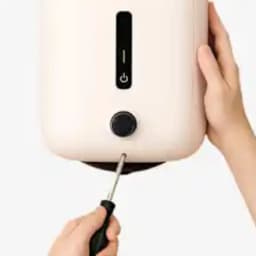
Cause: a thermostat that has drifted or a partially burnt element. What we do: measure the actual water temperature against the setting, test the thermostat and element, and replace whichever is at fault.
Water becomes very hot and the valve keeps spitting
Cause: thermostat contacts stuck closed, with the thermal cut-out as the last line of defence. What we do: replace the thermostat immediately and check the cut-out and pressure valve. Overheating tanks are dangerous.
Rusty, brown or smelly hot water
Cause: the magnesium anode rod has dissolved and the tank has started corroding. What we do: pull the anode rod out, show it to you, replace it, and flush the tank. If the inner tank is already badly corroded, we tell you honestly.
Leaking from the bottom or the pipe joints
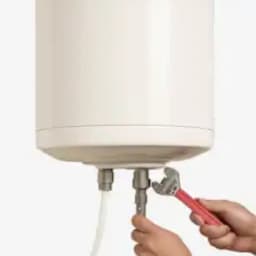
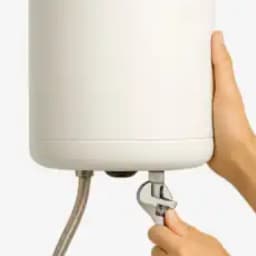
Cause: loose or corroded inlet and outlet connections, a failed pressure valve, or a leaking inner tank. What we do: fix joints and valves; if the tank itself leaks, replacement is usually the only safe option.
What Rewa's Climate and Water Do to a Water Heater
Rewa sits on a limestone belt, the same geology that supports the area's cement industry. Groundwater that passes through limestone picks up hardness, and a lot of homes use borewell water, either as their main supply or when municipal supply hours are short. Hard water is the single biggest enemy of a storage geyser. Heated above about 60°C, its minerals drop out as scale on the element and as sediment at the tank bottom. That is why we often hear a popping or crackling sound from geysers in Rewa: water trapped under sediment flashing to steam.
Winter here is real. December and January nights regularly drop to around 8°C or lower, and the city has recorded temperatures close to freezing. Geysers run long hours every morning and evening for three months. That concentrated, heavy use exposes every weakness: thin wiring heats up, worn thermostats stick, and scaled elements finally burn out.
Then comes the opposite extreme. From April to June, Rewa's afternoons are often in the forties and the geyser is switched off for months. Water sitting in the tank keeps attacking the anode rod and depositing scale, and bathroom humidity in the monsoon corrodes terminals and screws. When the cold returns, the damage is revealed all at once.
Voltage swings add stress. Many households see dips in the evening and spikes when supply is restored after a cut. Element life shortens, and thermostats and indicator lamps fail more often.
Our Repair Approach, Step by Step
- We isolate the supply and test earth continuity before touching anything.
- Insulation resistance of the element and wiring is measured.
- Voltage and current draw are checked with the geyser running.
- The thermostat is tested against a real water temperature reading.
- We drain a sample from the tank to check for sediment and rust.
- The anode rod is removed and inspected.
- The pressure valve and pipe joints are tested for leaks and function.
- You receive a clear quote. Work begins only after you agree.
- After repair, we heat a full tank and confirm the cut-off temperature and safety devices work.
An Honest Word on Parts and Cost
We do not quote fixed prices over the phone because "not heating" could be a loose wire or a burnt element and a failed thermostat together. What affects the cost is clear: elements and thermostats are routine parts, while a valve or anode replacement adds a little. A full descaling job involves draining, removing the element and flushing the tank, which takes more time. A leaking inner tank generally cannot be repaired sensibly, so in that case we recommend replacement rather than charging you for a temporary patch. Genuine parts for some brands cost more than compatible ones; we explain the difference and let you choose.
Instant, Storage and Gas Geysers
Storage geysers of 15 to 25 litres are the most common in Rewa bathrooms. Instant geysers of 3 to 6 litres are used in kitchens and for quick hand-washing; their thin elements are particularly sensitive to hard water. Some older homes still use gas geysers. If yours is gas-powered, it must be installed with proper ventilation, never inside a closed bathroom. Gas geysers in poorly ventilated spaces can produce carbon monoxide, which can be fatal. We will check the installation and tell you plainly if it is unsafe.
Safe Installation and Lower Bills Through the Winter
A geyser should hang on a solid wall with proper anchor bolts, because a full 25-litre tank is heavy. It needs a dedicated, earthed point with its own MCB, a pressure release valve that is not blocked or capped, and a drain outlet so it can be flushed. In many older Rewa houses, the bathroom point is shared with other appliances and lacks a reliable earth. We fix that during installation or repair, because an unearthed geyser is a shock hazard in a wet room.
To keep electricity bills under control during the cold months, set the thermostat to about 50 to 55°C rather than the maximum, switch the geyser on only 15 to 20 minutes before baths, and switch it off afterwards. A descaled element heats noticeably faster. If you are buying new, a well-insulated, higher star-rated model pays back the difference within a few winters in a hard-water city like Rewa.
A Simple Geyser Calendar for Rewa
| Month | What Is Happening | What to Do |
|---|---|---|
| October to November | Cold approaching, geyser about to restart | Book a full service: descale, anode check, thermostat and earth test |
| December to January | Peak cold, long daily use, everyone needs repair at once | Set thermostat to 50 to 55°C; switch off after use |
| February to March | Usage tapers off | Note any slow heating or noise for next service |
| April to June | Extreme heat, geyser idle | Drain or run occasionally; keep switch off at the MCB |
| July to September | Monsoon humidity in the bathroom | Check for damp walls and corroded terminals near the geyser |
Areas We Serve in Rewa
Our technicians reach Civil Lines, Indira Nagar, Amahiya, Nehru Nagar, Sirmour Chowk, Samaan, Ratahara, Dhobia Tanki, Kothi Compound, Bodabagh, Chirhula, Ghoda Chowk, Rani Talab, Uprahati, Padra, Anantpur, Itaura, Bichhiya, Nipaniya, Chorhata and University Road.
Geyser Brands We Repair
Havells, Racold, Bajaj, AO Smith, V-Guard, Crompton, Orient, Venus and Haier, in storage, instant and gas models.
Why Rewa Families Trust AC Care India
- Technicians are verified and trained in electrical safety for wet areas.
- You get a clear quote before any part is changed.
- Our repairs and replaced parts carry a warranty.
- Genuine or quality compatible spares, with full transparency.
- Same-day or next-day visits in most colonies, even in the winter rush where possible.
- A straight answer when a tank is not worth saving.
AC Care India is an independent appliance repair service that works on many brands. We are not the authorised service centre of any geyser company, and brand names on this page only describe the products we repair. If your geyser is still under the manufacturer's warranty, please contact them first.
Book Geyser Repair in Rewa
Call or WhatsApp 9266608882, or book through this page. Tell us your colony, the brand and capacity, and whether you use borewell or municipal water. Book in October or November and you will start the winter with a geyser that heats quickly, safely and cheaply.
