

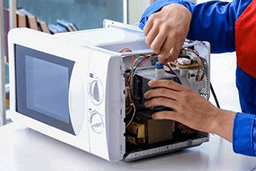


Why Does My Microwave Hum and Turn the Plate but Leave the Food Cold?
That is one of the most common questions we get from Bulandshahr households, and the answer is usually inside the high-voltage section. When the light comes on, the turntable turns and the fan runs but nothing heats, the magnetron is not producing microwaves. That can be because the magnetron itself has failed, or because the high-voltage diode, capacitor, transformer or a thermal fuse in that circuit has. None of these parts should be touched by anyone untrained. The capacitor in a microwave can hold a dangerous charge for a long time after the plug is pulled.
What is interesting is how strongly microwave faults in this district follow the calendar. Summer heat, monsoon damp, festival baking and winter reheating each bring their own problems. This page walks through the year, then covers what a proper microwave repair in Bulandshahr includes when AC Care India sends a technician.
April to June: Kitchen Heat and Unstable Power
Bulandshahr's summer peaks in May, when afternoon temperatures average around 41°C and can climb to 45°C. Kitchens in older houses, with a gas stove running and little cross-ventilation, get hotter still. A microwave depends on its cooling fan and side vents to keep the magnetron and transformer within safe temperatures. In a kitchen like that, especially when the oven is pushed into a cramped shelf with no gap at the sides, internal temperatures rise quickly.
The result is the classic summer symptom: the oven starts heating, then stops mid-cycle, or shuts down altogether. Often a thermal cut-out has tripped to protect the magnetron. If the heat continues season after season, the magnetron weakens and the fan motor bearings dry out.
Power is the other summer issue. Load-shedding and the surge when supply returns stress the main control board, the transformer and the door interlock switches, which carry a heavy current each time the oven starts. Unplugging the microwave during long cuts, and switching it on a minute or two after power returns rather than immediately, prevents a lot of damage.
July to September: Damp, Rust and Sparking
When the monsoon sets in, kitchen humidity rises sharply, especially in households that boil milk, steam rice and fry pakoras through the rainy evenings. Steam from cooking inside the microwave also condenses on the cavity walls. Two problems follow.
Sparks from the cavity
Moisture and food splashes slowly soak the waveguide cover, the small mica or composite sheet on the inside wall. Once it carbonises, it arcs and sparks. Damp also lifts the paint inside the cavity, and exposed metal can spark too. Both are fixable if caught early, but ignoring sparking can damage the magnetron.
Touch panels and boards
Membrane keypads absorb moisture and start registering phantom presses, or stop responding. Thunderstorms send surges through the wiring and can knock out the control PCB in one strike.
October and November: Festivals, Baking and Heavy Use
From Dussehra through Diwali and into the wedding season, many kitchens use the convection mode far more than at any other time of year: cakes, cookies, nankhatai, grilled paneer and reheated sweets for guests. Convection runs a separate heating element and fan at high temperature for long stretches. Heater elements burn out, convection fan motors seize, and the extra heat stresses door seals and the interlock switches.
This is also when we see the most turntable problems. Heavy glass or steel dishes, forced in and out repeatedly, crack the coupler under the plate and strain the small turntable motor. A turntable that stops turning or turns in jerks is usually a cheap part, but leaving it means food heats unevenly and the plate can overheat.
December to February: Cold Fog and Constant Reheating
Winter in the district brings cold nights around 8°C and long spells of dense fog. Households reheat tea, milk, rotis and leftovers several times a day, so the door is opened and closed constantly. Door switches and latches wear out, and a misaligned door can stop the oven starting at all, since the interlock will not allow heating with the door unsealed. Condensation also forms inside ovens kept in cold, damp kitchens and is worth wiping out before use.
Winter is also a good time to service a microwave that showed weak heating through the year, because demand on technicians is lower than at festival time.
Small Habits That Prevent Most Repairs
Most of the ovens we open in the district did not fail suddenly. They were worn down by a few everyday habits that are easy to change.
- Leave breathing room. Keep at least ten centimetres free at the sides and back, and never stack containers or a fruit basket on top of the vents.
- Never run it empty. With nothing inside to absorb the energy, microwaves bounce back into the magnetron and overheat it. Children testing buttons are a common cause.
- Watch the utensils. Steel tiffins, foil, plates with gold or silver borders and some printed melamine sets cause arcing. Use glass, ceramic or containers marked microwave-safe.
- Cover what splatters. Dal, curries and milk boil over and soak the waveguide cover. A simple vented lid saves that part.
- Wipe after use. Clean the cavity and door seal with a damp cloth once it cools, and dry it during the monsoon so moisture does not sit overnight.
- Use a surge protector. A good spike guard on the microwave socket is cheap insurance against the voltage jumps that follow load-shedding.
- Do not lean on the door. Hanging bags or towels from the handle slowly bends the hinges and misaligns the interlock.
Faults and Likely Causes at a Glance
| Symptom | Probable Cause | Season It Peaks in Bulandshahr |
|---|---|---|
| Runs but does not heat | Magnetron, HV diode, HV capacitor or thermal fuse | Summer, after heat build-up |
| Sparking inside cavity | Damaged waveguide cover, peeling cavity paint, metal utensils | Monsoon |
| Keypad unresponsive or erratic | Moisture in membrane, surge-damaged PCB | Monsoon |
| Turntable not turning | Broken coupler or failed turntable motor | Festival season |
| Convection not heating | Burnt heater element or convection fan | Festival season |
| Fuse blows when door shuts | Faulty door interlock or monitor switch | Winter, from heavy use |
| Loud buzzing or humming | Weak magnetron, transformer or fan motor | Summer |
| Display dead after power cut | Blown fuse or failed board power supply | Summer and storms |
Our Ten-Point Microwave Service Checklist
- Check socket voltage and earthing before plugging the oven in.
- Safely discharge the high-voltage capacitor before opening the casing.
- Test the main fuse and all door interlock switches with a meter.
- Check the magnetron for continuity and insulation to its body.
- Test the high-voltage diode and capacitor.
- Inspect the transformer windings for burning or a smell of overheating.
- Examine the waveguide cover and cavity paint for carbon or rust.
- Test the turntable motor, coupler and roller ring.
- On convection and grill models, check the heater element, convection fan and thermostat.
- Run a water-load heating test after repair and measure door seal leakage.
Things We Will Not Do
- Bypass a door interlock switch to make the oven run. It is the main safety barrier against microwave exposure.
- Repaint a rusted cavity with ordinary paint, which can itself spark.
- Replace a magnetron on an oven whose cavity has rusted through; we will recommend replacement instead.
- Promise a timeline for parts we do not have in hand. If a board must be ordered, we tell you so.
Bulandshahr Areas We Serve
Our technicians come out to Krishna Nagar, DM Road, Awas Vikas Colony, Kala Aam, Civil Lines, Khurrampur, Bhoor, Yamunapuram, Siyana Road, Kotwali area, Delhi Road, Shikarpur Road, Agra Road and Anoopshahr Road, and on planned days to Khurja, Sikandrabad, Gulaothi, Siyana and Narora.
Microwave Brands We Repair
Solo, grill and convection ovens from Samsung, IFB, Panasonic, Bajaj, Whirlpool, Godrej and Morphy Richards, including built-in models. Older ovens bought years ago from local electronics shops are welcome too, as long as spares can still be found.
Book Microwave Repair in Bulandshahr
With AC Care India you get a verified technician, a clear quote before any work, genuine or quality-matched spares, and a warranty on both the repair and the parts. Visits are same-day or next-day in most localities, and if the oven is not worth fixing, you will hear it from us directly. AC Care India is an independent repair service for multiple brands and is not any manufacturer's authorised centre; brands are named only to identify the ovens we work on, and in-warranty units should be sent to the brand first.
Call or WhatsApp 9266608882, or book online through this page. Tell us the brand, whether it is solo, grill or convection, and what is happening. A safe, properly tested microwave repair in Bulandshahr is far better than an oven that sparks through the festival season.
