

Why Does My Microwave in Rampur Hum but Not Heat the Food?
That is one of the most common questions we hear from Rampur homes. The turntable is going round, the light is on, the timer counts down and the fan is blowing, yet the plate of rice or the cup of milk comes out as cold as it went in. In nearly every case the fault is in the high-voltage section: the magnetron that makes the microwaves, the high-voltage diode, the high-voltage capacitor or the transformer that powers them. Occasionally it is a door switch that lets the lamp and fan run but cuts the heating circuit.
What makes it more likely in Rampur is a mix of the local power supply, the summer heat, the dust and the way kitchens here are used. This page explains those local factors first, then lists the faults we fix, walks you through a microwave repair visit from AC Care India, and tells you what you can safely check yourself and what you must leave alone.
One safety point before anything else: a microwave's high-voltage capacitor can hold a dangerous charge even after the plug is pulled. Please do not open the outer cabinet yourself.
Rampur's Power Supply and the Microwave's Electronics
A microwave oven is a hungry appliance for a few minutes at a time. On full power it draws well over a kilowatt, and that load lands suddenly on the kitchen circuit. In many Rampur homes, especially older ones in the walled-city lanes and around the Qila, wiring was laid for lights and fans, not for a microwave, a mixer and an electric kettle on the same socket board.
Evening voltage in the city often sags when everyone switches on coolers and ACs, and when supply returns after a cut, there can be a brief spike. Low voltage makes the transformer and magnetron run inefficiently and hotter; a spike can blow the main fuse, damage the touch panel's power supply, or burn the varistor that protects the board. Pre-monsoon thunderstorms with lightning add another risk. We regularly see microwaves that died on a stormy evening while plugged in but switched off at the panel.
What helps
- Give the microwave its own 16-amp socket rather than an extension board shared with the fridge and mixer.
- Use a surge protector, and unplug the oven during thunderstorms.
- Make sure the socket has a working earth; a microwave with a metal body must be earthed.
Heat, Dust, Steam and Oil in a Rampur Kitchen
From April to June, Rampur kitchens can be hotter than the outdoors by afternoon, with a gas stove running and the window shut against the loo. A microwave cools its magnetron with a small fan that pulls air through vents at the side or back. If those vents are pushed against a wall or blocked by a stack of utensils, the magnetron overheats, and its built-in thermal fuse may cut out or the magnetron itself may weaken over time.
Fine dust from the dry season settles on the cooling fan and inside the vents. Mix that with oil vapour from tadka and frying, a daily feature of Rampur cooking with its kormas, kebabs and parathas, and you get a sticky paste that slows the fan and coats the electronics.
The monsoon then brings humidity and condensation. Steam from reheating food without a cover settles inside the cavity, and over the years it lifts the paint on the cavity walls. Exposed metal under that paint can spark. The mica waveguide cover, a thin sheet on the side of the cavity, absorbs grease and moisture until it burns, which is the usual cause of a sudden bright spark and a burning smell.
How Rampur Families Use Their Microwaves
In most homes the microwave is used for reheating: dal, sabzi, rotis wrapped in a cloth, milk for tea, leftovers from a dawat. Some families use the convection mode to bake cakes for birthdays and Eid, or the grill to finish kebabs. Each use stresses different parts. Frequent short reheats wear the door switches and the relay on the control board. Convection baking runs the heating element and its fan for long periods. Grilling coats the cavity roof with oil. Knowing how you use the oven helps our technician check the right places first.
Small habits that prevent big repairs
- Cover food with a microwave-safe lid when reheating, so steam and splatter stay off the cavity walls and mica sheet.
- Never run the oven empty; with nothing to absorb the energy, the magnetron takes the punishment.
- Keep steel tiffins, foil and plates with gold or silver borders out of microwave mode. They are fine in convection mode only, on the rack the manual specifies.
- Wipe the cavity once a week with a damp cloth, and steam a bowl of water with lemon to loosen stuck grease.
- Leave at least a hand's width of space at the sides and back, and more at the top, for cooling air.
Symptoms, Causes and What We Do
| What Happens | Probable Cause | Repair Approach |
|---|---|---|
| Runs but food stays cold | Failed magnetron, HV diode, HV capacitor or transformer | Safe discharge, test each HV part, replace the faulty one |
| Completely dead, no display | Blown main fuse from a surge or failed door switch | Check door interlocks, replace fuse, test board power supply |
| Sparks and crackling inside | Burnt mica cover, peeling cavity paint, metal utensil | Replace waveguide cover, treat cavity with safe enamel |
| Turntable not rotating | Worn turntable motor or broken coupler | Replace motor or coupler, check roller ring |
| Some touch keys do not respond | Moisture or grease under the membrane keypad | Clean contacts or replace keypad |
| Convection mode not heating | Burnt heater element or convection fan motor | Test and replace heater or fan |
| Loud buzzing or humming | Failing magnetron, loose transformer, dry fan bearing | Test magnetron, tighten mounts, replace fan motor |
| Door does not close properly | Broken latch hook or misaligned hinge | Replace latch, realign door, test for leakage |
What Our Technician Does at Your Door
- Asks how the oven is used and when the problem began.
- Checks the socket voltage and earth before plugging the oven in.
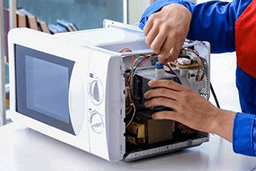
- Unplugs the oven, opens the cabinet and discharges the high-voltage capacitor with an insulated tool.
- Tests the fuse, door interlock switches, magnetron, diode, capacitor and transformer with a meter.
- Inspects the cavity, mica cover, turntable motor and cooling fan.
- Explains the fault and gives you the quote before replacing anything.
- Fits the part, cleans the cooling path and vents, and reassembles the oven.
- Heats a cup of water to confirm the oven is working, and checks door sealing.
What You May Check Yourself, and What to Leave to Us
Safe for you to check
- Whether the socket works, by plugging in a lamp or phone charger.
- Whether the door closes with a firm click on both sides.
- Whether the turntable is seated properly on its coupler and roller ring.
- Whether the child lock is on; many models show a lock symbol.
- Whether a burnt spot is visible on the mica sheet inside the cavity.
Call a technician for
- Anything that involves removing the outer cover.
- Repeated fuse blowing or a burning smell.
- Sparking that continues after cleaning the cavity.
- A damaged door, glass or hinge, because the door seal is what keeps microwaves inside.
Microwave Brands We Repair
Solo, grill and convection models from Samsung, IFB, Panasonic, Whirlpool, Morphy Richards, Bajaj and Godrej. AC Care India is an independent multi-brand service, not an authorised centre of any manufacturer; the brand names only describe the ovens we work on. For an oven still under its company warranty, please approach the brand first.
When you book with us, you get a verified technician, a clear quote before the work, warranty on the repair and parts, genuine or well-matched spares, same-day or next-day visits in most of Rampur, and honest advice.
Rampur Areas We Visit for Microwave Repair
Civil Lines, Ajitpur, Jwala Nagar, Ganj, Jail Road, Shadab Market, Awas Vikas Colony, Nawab Gate, Shahbad Gate, the Qila and Hamid Manzil side, Tope Khana, Pilakhana, Bareilly Road, Moradabad Road, Kosi Road, the Sarrafa and Jama Masjid lanes, and Milak and Bilaspur on request.
Is It Worth Repairing?
Most microwave faults, including door switches, fuses, turntable motors, keypads and diodes, are well worth fixing. A magnetron replacement is usually worthwhile on an oven under six or seven years old. If a convection oven over eight years old needs both a magnetron and a control board, or if the cavity is rusted through, replacement often makes better sense, and we will tell you so rather than sell you parts. To book, call or WhatsApp 9266608882 or book online through this page, and mention the brand and what the oven is doing.
