






Hard Tubewell Water, Dust Storms and a Shaky Supply: What Saharanpur Does to a Washing Machine
Saharanpur washes its clothes in groundwater. Almost every home draws from municipal tubewells or a private submersible, and that water carries moderate to high hardness across most of the city. Every wash leaves a little calcium behind on the heater, the drum, the inlet valve and the pipes. The city's weather adds its own load: dust storms from April to June that leave grit in overhead tanks and inlet filters, a monsoon of roughly a metre of rain that keeps laundry areas damp for three months, and winter fog that rusts anything steel left on a balcony. Then there is the power: evening voltage sag in the older colonies and surges when supply returns after a cut. To understand why washing machine repair service in Saharanpur is needed so often, it helps to walk through the machine part by part and see what each of these pressures does to it.
A Washing Machine, Part by Part, Under Saharanpur Conditions
Inlet valve and filter
The solenoid valve opens to let water in, and a small mesh filter sits just before it. In this city the mesh clogs with sand from the tubewell and scale flakes from the pipes; the valve's rubber diaphragm hardens with mineral deposits. The result is slow filling, inlet error codes, or a valve that does not close fully and lets water seep in overnight.
Heater element and thermistor
Front-loaders heat their own water. On hard groundwater the element grows a crust of scale that insulates it, so it runs hotter and longer until it burns out or its insulation breaks down and trips the RCCB. The thermistor beside it drifts as scale coats it. Families who run hot washes for woollens in Saharanpur's cold winters see this earliest.
Drum, spider and bearings
The stainless drum is carried on an aluminium spider that corrodes in the alkaline, mineral-rich residue left by hard water and excess detergent. The bearings behind it are sealed, but a worn seal lets water through and the bearing rusts. A rumble on spin that grows week by week is this bearing; a banging drum with play when you push it is a failing spider.
Drain pump and filter
The pump pushes dirty water out through a coin trap. Here it collects grit, lint from the thick cotton and woollens the winter demands, and the odd hairpin. A jammed impeller means water standing in the drum at the end of the cycle.
Motor, belt and clutch
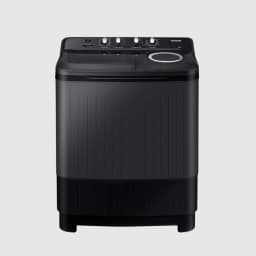
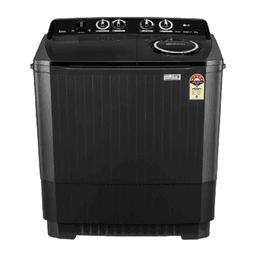
Top-loaders and semi-automatics drive the drum through a belt and, on fully automatic top-loaders, a clutch. Belts glaze and slip when the drum is overloaded with heavy winter quilts; clutches wear and the drum stops agitating though the motor runs. Universal motors in front-loaders wear their carbon brushes faster under low voltage.
Suspension, shock absorbers and springs
These keep the drum from walking across the floor on spin. Saharanpur's older houses often have uneven floors, and a machine that was never levelled hammers its shock absorbers flat within a couple of years.
Door lock, lid switch and gasket
The door lock holds the door shut while the drum turns; the gasket seals it. In a damp monsoon laundry corner the gasket grows black mould in its folds and the lock's contacts corrode. A machine that will not start, or shows a door error, often has nothing more than a tired lock.
Control PCB and display
The board runs everything. It is the part most likely to die from a surge after a power cut, and in homes where the machine sits in a semi-open courtyard, from humidity creeping onto its tracks. Board repair at component level is often possible and far cheaper than replacement.
The Diagnostics We Run on a Saharanpur Visit
- Socket earth and supply voltage checked before the machine is plugged in.
- Inlet flow rate tested at your tap, since low pressure from an overhead tank mimics a valve fault.
- Inlet filter and valve opened, cleaned and tested.
- Heater element resistance and insulation measured; thermistor checked against a thermometer.
- Drum spun by hand for bearing noise and pushed for spider play.
- Drain pump opened, cleared and run.
- Belt tension, clutch engagement and motor brushes inspected.
- Shock absorbers and springs checked; machine levelled.
- Door lock, lid switch and gasket tested and inspected for mould.
- PCB examined for burnt tracks, corrosion and relay wear; a test cycle run before the technician leaves.
Parts, How Long They Last on Saharanpur Water, and the Early Warnings
| Part | Typical Life Here | Warning Sign |
|---|---|---|
| Inlet valve and filter | Filter needs cleaning every 2 to 3 months; valve 5 to 8 years | Slow fill, inlet error, drips when off |
| Heater element | 3 to 5 years without descaling; longer with quarterly descaler washes | Cold washes on hot setting, RCCB trips |
| Drum bearings and seal | 6 to 10 years; less if overloaded | Rumble on spin, rust streaks on clothes |
| Drum spider | 7 to 10 years | Banging, drum play, metallic clunk |
| Drain pump | 5 to 8 years | Water left in drum, humming at drain stage |
| Belt | 3 to 5 years | Burning rubber smell, drum not turning |
| Shock absorbers | 4 to 7 years | Machine walks or bangs on spin |
| Door lock | 4 to 6 years | Door error, will not start |
| Control PCB | 7 to 10 years with surge protection | Dead display, random stops, wrong cycle |
Winter Loads, Low Pressure and the Semi-Automatic Question
Two local habits deserve their own note. The first is the winter load. From November to February Saharanpur washes quilts, blankets, shawls and heavy woollens, often in a machine rated for six or seven kilograms that is being asked to spin twelve. That is what flattens shock absorbers, glazes belts and strains top-loader clutches, and it is why our winter call sheet is full of banging drums. Wash heavy items one at a time, and use the dedicated blanket cycle if the machine has one. The second is pressure. Most homes here fill from an overhead tank that is itself filled by a submersible pump once or twice a day. At the tail end of the tank, or on a second floor with the tank barely above, a fully automatic machine may not get the flow its inlet valve expects and will time out with an error. Semi-automatics, which the owner fills by hand or hose, do not care, which is one reason they remain so popular in the city's older houses. If you are choosing between the two for a low-pressure home, say so when you call and we will tell you honestly what will work.
Installation, Shifting and Annual Care
We install new machines with a check of inlet pressure, a proper drain height and a levelled stand, and on front-loaders we remove the transit bolts, which a surprising number of Saharanpur machines are still running with. When you shift within the city, we refit the bolts, move the machine and reinstall it. Hostels, hospitals, guest houses and the dhobi-style laundries that serve the city's hotels can take an annual maintenance contract covering descaling, filter cleaning and a pre-winter check, when the heavy woollen loads begin.
Brands We Service in Saharanpur
Semi-automatic, top-load fully automatic and front-load machines from IFB, Samsung, Whirlpool, Bosch, Godrej, Haier, Panasonic and Voltas Beko. Semi-automatics and top-loaders remain the majority in Saharanpur's homes and we keep their motors, belts, timers, clutches and valves in stock; front-loaders in the newer colonies get board-level diagnosis rather than a guessed swap.
AC Care India is an independent multi-brand repair service and is not the authorised service centre of any washing machine manufacturer; brand names above describe only the machines we repair. For a machine still under warranty, contact the brand first.
Neighbourhoods Covered
Gill Colony, Civil Lines, Court Road, Mission Compound, Hakikat Nagar, Kishanpura, Shastri Nagar, Janakpuri, Gopal Nagar, Patel Nagar, Nawabganj, Pul Kamboh, Ghantaghar, Nehru Market, Delhi Road, Ambala Road, Chakrata Road, Dehradun Road, Paper Mill Road, Behat Road, Khan Alampura, Ahmed Bagh, Manakmau, Transport Nagar and Gandhi Colony.
Why Saharanpur Calls AC Care India
- Verified technicians who know scale from sand and a pressure fault from a valve fault.
- A written quote before any part is fitted.
- Warranty on both labour and parts.
- Genuine or tested-compatible spares.
- Same-day or next-day visits across most of the city.
- Honest advice when a cracked tub on an old semi-automatic means replacement is the better spend.
Book Washing Machine Repair Service in Saharanpur
Call or WhatsApp 9266608882, or book online through this page. Tell us the brand, the type of machine and whether your water comes from a municipal line or your own submersible; on the harder private supplies the technician brings descaler and a spare element as a matter of course.
