


AC Not Cooling in Amroha? Rule Out These Four Things Before Booking
When an air conditioner struggles in the middle of an Amroha June, the first instinct is to call for a gas refill. Hold on for ten minutes and go through this short triage. It saves a wasted visit more often than you would expect.
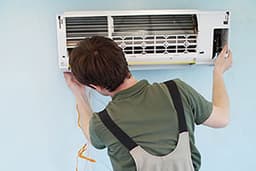
- Look at the filters. Lift the front panel of the indoor unit and slide out the mesh filters. After a dusty spring, they are often grey and solid. Wash them under a tap, dry them in the shade and refit.
- Check the voltage. If the ceiling fan is crawling and tube lights look dim, the supply is low. Many ACs, especially non-inverter models on a weak stabiliser, will run the fan but refuse to start the compressor until voltage recovers.
- Go and see the outdoor unit. Is the fan spinning? Is the unit buried behind stored cots, a cooler body or a heap of bricks on the roof? A condenser that cannot breathe cannot cool.
- Check the remote mode. A remote stuck in fan or dry mode, or a sleep timer left on, can make a healthy AC feel broken.
If none of these explains it, the fault is inside the machine. The rest of this page takes an AC apart, component by component, and explains what Amroha's heat, dust and power supply do to each part, and how AC Care India handles AC service in Amroha.
Inside a Split AC: The Parts That Do the Work
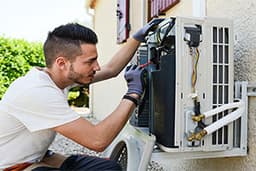
A split air conditioner is two boxes joined by copper pipes and a cable. The indoor unit holds the evaporator coil, a blower fan, filters, a drain tray and a control board. The outdoor unit holds the compressor, the condenser coil, a large fan, a capacitor and, on inverter models, a second control board. Refrigerant circulates between them in a sealed loop, carrying heat out of your room and releasing it outside. When any one part weakens, the others work harder to compensate, which is why one small fault can snowball into a bigger one in peak summer.
Compressor: Worked Hardest in an Amroha Summer
The compressor squeezes refrigerant vapour and pumps it around the loop. It is the costliest part of the AC and, when looked after, the longest-lived. In Amroha, the cooling season runs roughly from April to September, with May and June afternoons commonly in the low to mid-forties. On those days, the compressor runs almost without a break. If the condenser is dirty or the voltage is low, its windings run hot and its current draw climbs.
The compressor rarely fails on its own. It usually fails because something around it was neglected: a dirty coil, a weak capacitor, repeated starts on low voltage, or a gas leak that left it running short of refrigerant and overheating. Protecting the compressor is really about maintaining everything else.
Condenser Coil and Outdoor Fan: Dust, Pollen and Roof Heat
The condenser releases the heat taken from your room. It is a block of thin aluminium fins wrapped around copper tubes, with a fan pulling air through it. Amroha sits in the middle of farmland and mango orchards, and the dry months bring dust from fields, unpaved lanes and the highway. In spring, flowering trees add pollen and fine fluff. All of this collects on the fins. A coil with a felt-like layer on its face can lose a large share of its ability to dump heat.
Many outdoor units in the city sit on flat roofs or on a narrow ledge facing a sunlit wall. On a roof in June, the air around the unit is already hotter than the forecast says. Shading the unit from direct afternoon sun, without blocking airflow, and keeping a clear space in front of the fan both help. The fan motor itself has bearings that dry out over time and capacitors that weaken, and a slow fan is one of the most common reasons we find for a compressor tripping on overload.
Capacitor, Contactor and the Power Problem
A non-inverter AC uses a run capacitor to start and keep the compressor and fan motors turning, and a contactor that switches the compressor on and off. Western Uttar Pradesh supply can sag in the evening peak and spike when power returns after a cut, and in the pre-monsoon storm season lightning adds sharper surges. Capacitors swell and lose value under this treatment; contactor points pit and stick. The result is the familiar complaint of an AC that hums, clicks, and then trips the MCB. Replacing a capacitor is a modest job and saves a compressor.
A correctly rated stabiliser matters, and so does a proper earth. In older houses in the walled mohallas, the AC is often wired into a circuit that was designed for a fan and a few bulbs. We check the cable size and the breaker before blaming the AC.
Inverter Boards and Sensors
Inverter ACs replace the simple capacitor-contactor setup with an outdoor PCB that varies compressor speed. They save power and hold temperature smoothly, but the board is sensitive to surges, heat and moisture. A burnt component on the outdoor board is the most common reason an inverter AC shows an error code and refuses to start after a storm. Thermistors, the small temperature sensors clipped onto coils and pipes, also drift with age and send wrong readings, so the AC cuts out early or never reaches set temperature. We read the error code, test the sensors and board, and repair at component level where that is reliable.
Evaporator, Blower and Drain: The Indoor Side
The evaporator coil inside the room gets cold and pulls heat and moisture out of the air. Dust that slips past the filters coats it, and when the monsoon arrives in July, Amroha's humidity turns that dust into a sticky film where mould grows. That is the source of the sour smell many people notice when the AC starts after the rains. The blower wheel collects the same grime, cutting airflow. Moisture condensed on the coil drips into a tray and leaves through a drain pipe. If that pipe is blocked by algae, or was laid without enough slope, water overflows onto the wall.
Refrigerant and the refill habit
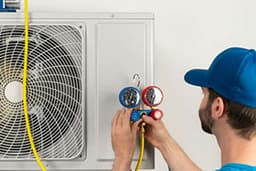
Gas does not get consumed. If an AC needs gas every season, it has a leak, usually at a flare nut, a brazed joint or a pinhole in a coil. We pressure-test with nitrogen, locate and fix the leak, pull a vacuum and then charge by weight. Repeated top-ups without finding the leak only delay the compressor damage that low gas causes.
How We Diagnose an AC in Amroha
- Supply voltage at the socket, both at rest and when the compressor starts.
- Running current of the compressor and fan motors against their rated values.
- Capacitor value test with a meter, and contactor contact inspection.
- Suction and discharge pressure, plus the temperature drop across the indoor coil.
- Error code reading and sensor resistance checks on inverter models.
- Insulation and earth leakage test on wiring and the compressor.
- Coil condition on both units, and a drain flow test.
- Bracket, stand and pipe insulation inspection.
AC Parts, How Long They Last and the First Warning
| Part | Typical Life With Yearly Service | Early Warning Sign |
|---|---|---|
| Compressor | 10 to 12 years or more | Very hot body, loud hum, repeated overload trips |
| Run capacitor | 3 to 5 years; less on unstable supply | Clicking, slow fan, compressor not starting |
| Outdoor fan motor | 6 to 8 years | Fan slow or noisy, unit cutting out in afternoon heat |
| Indoor blower motor | 7 to 10 years | Weak air throw, rattling from indoor unit |
| Inverter PCB | Varies; most failures follow surges | Error code on display, unit dead after a storm |
| Thermistors | 5 to 8 years | Erratic cut-outs, not reaching set temperature |
| Copper insulation | 4 to 6 years in sun | Cracked foam, sweating pipes, dripping outside |
Installation, Shifting and Annual Contracts
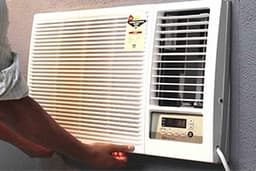
We install split and window ACs with properly sized copper, sealed wall holes, a drain pipe that actually slopes, and brackets or roof stands rated for the weight. For rooftop units, we raise the stand off the slab so monsoon water does not pool around the base. When you move house within Amroha, we pump down the gas into the outdoor unit before disconnecting, so it is not wasted, and reinstall with a fresh leak test. Shops, clinics, coaching centres and offices can take an annual maintenance contract with a pre-summer service in March, a post-monsoon cleaning in September or October, and priority response during the hot months.
AC Brands We Repair
Split, window and inverter units from Voltas, Daikin, Samsung, Lloyd, Blue Star, Hitachi, Carrier, Panasonic, Godrej, Whirlpool, O General and Haier, including older non-inverter models that are still common in the city.
Where Our Technicians Work in Amroha
Civil Lines, Station Road, Joya Road, Hasanpur Road, Naugawan Sadat Road, Mohalla Kot, Danishmandan, Katra Ghulam Ali, Guzri, Chah Gori, Bagla, Mandi Chob, Majapota, Naugaza, Lakra, Nai Basti, the Kachehri area and the newer colonies off the bypass. Visits to Gajraula and Joya can be arranged.
Book AC Service in Amroha
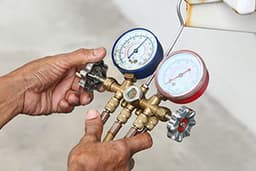
With AC Care India, you get a background-verified technician who carries gauges and a clamp meter, a clear quote before any work, original or tested compatible spares, and a warranty on the repair. Most of the city gets a same-day or next-day slot, and if your old AC is not worth a major repair, we will tell you honestly. We are an independent multi-brand service company and not the authorised service centre of any AC manufacturer; brand names are used only to identify the units we service, and an AC still under brand warranty should go to the company first. Call or WhatsApp 9266608882, or book online through this page.
