




Ten at Night in Kadappakada, 29 Degrees, and the AC Is Dripping on the Bed
The fan is on, the windows are shut against the mosquitoes, and the split AC in a first-floor bedroom off Kadappakada has been running since dinner. The thermometer says 29°C, which does not sound hot, but the air is so wet that the bedsheet feels damp and the family cannot sleep without the machine. Then the drip starts: a steady tap of water from the indoor unit's right corner onto the mattress. Nobody has touched the AC since it was installed. The filters have never been washed, the drain pipe has not been flushed, and the outdoor unit on the sea-facing wall has fins the colour of old tea. This is a typical Kollam service call, and it has very little to do with heat.
What follows explains what Kollam's coast does to an air conditioner, how to read the symptoms, and how AC Care India approaches AC service in Kollam so that the repair lasts through the next monsoon.
Humidity Is the Load, Not Temperature
Kollam rarely gets properly hot. Daytime highs sit between 31 and 35°C through the year, and even March and April, the warmest months, seldom go beyond 36°C. What the city has instead is relative humidity that stays above 70 percent almost every day and climbs past 85 percent in the monsoon. An air conditioner cools a room partly by chilling the air and partly by condensing water out of it, and in Kollam the second job is the bigger one. The evaporator coil drips litres of water every hour, all of which has to flow through a thin drain pipe. Dust, algae and the fine grey mould that grows on anything damp here build up inside that pipe within a season. That is why water leaks are the most common complaint we attend, and why "the AC is on but the room feels sticky" usually means the unit is undersized, the coil is dirty or the machine is cycling too quickly to dehumidify.
Humidity also attacks the electrics. Connector blocks, relays and the outdoor PCB on inverter units corrode slowly in air that never dries. Copper insulation rots, the pipe sweats, and water tracks back along the wall into the room.
Salt Air, Monsoon Wind and Lightning
From Thangassery and Kollam Beach through Sakthikulangara, Neendakara and up the coast to Chavara, the air carries salt. Aluminium fins on the outdoor coil pit and crumble, copper tubing develops pinhole leaks, and screws and brackets rust through in a few years. Units a kilometre or two inland in Asramam or Thevally fare better but are not spared. A blue-fin or anti-corrosion coating on the condenser is worth paying for in this town, and so is a cover during the months the AC is idle.
The south-west monsoon arrives in early June with driving wind and rain that lasts into September, and the north-east monsoon follows through October and November. Outdoor units on west-facing walls take the rain head-on; water enters the electrical box, fan motors seize, and mounting brackets loosen in the wind. Before that, in April and May, Kerala has some of the heaviest lightning activity in India. Surges through the mains destroy inverter boards, and we see a run of "AC suddenly dead" calls after every big pre-monsoon storm. A surge protector and the habit of switching the AC off at the MCB during a storm save a lot of money here.
Power supply in Kollam is generally steady, but monsoon tree falls on lines cause short, repeated outages. A compressor restarting against pressure several times an evening wears faster, so a stabiliser with a restart delay is useful.
Sizing, Mode and the "Gas Top-Up" Habit
Two local habits cost Kollam households money. The first is buying a bigger AC than the room needs, on the theory that it will cool faster. In a humid climate an oversized unit reaches the set temperature quickly, switches off before it has pulled much moisture out of the air, and leaves the room cold and clammy. A correctly sized inverter unit that runs longer at low speed dehumidifies far better. The second is the annual gas top-up. Refrigerant does not get used up; if the AC needs gas every year it has a leak, and near the coast that leak is usually a corroded coil or a flare joint loosened by the outdoor unit vibrating in monsoon wind. Finding and brazing the leak once, then charging the right weight, ends the yearly expense. We will not simply top up and leave.
Symptoms and What They Usually Mean in Kollam
| What You Notice | Most Likely Cause Here | Quick Check |
|---|---|---|
| Water dripping from indoor unit | Drain pipe blocked with algae, unit tilted | Look for water at the drain pipe outlet outside |
| Cool but room stays sticky | Dirty coil, oversized or short-cycling unit, fan on high | Set fan to low or auto and see if comfort improves |
| Cooling weak, pipe frosting | Refrigerant leak from corroded coil | Check for oil stains on outdoor coil |
| Musty smell on start-up | Mould on evaporator and blower | Shine a torch behind the filters |
| Outdoor fan silent, compressor hums | Fan motor seized by rust, capacitor dead | Observe whether the fan spins at all |
| Dead after a storm | Surge-damaged PCB or fuse | Confirm the MCB and socket are live |
| Rattling outdoor unit in wind | Corroded bracket, loose panel | Visually check mounting bolts |
| Inverter error code on display | Board, sensor or communication fault | Note the code before switching off |
What a Service Visit Looks Like
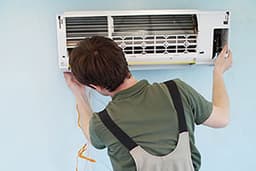
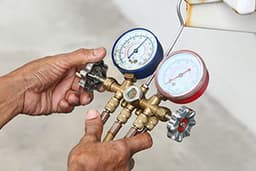
The technician starts with the drain, because in Kollam it is the first suspect: the line is flushed and its slope checked. The filters are washed and the evaporator coil and blower wheel are foam-cleaned to remove mould rather than just rinsed. Outside, the condenser is jet-washed from the inside out, bent fins are combed, and the coil and pipe joints are inspected for the green-white corrosion that marks a leak. Refrigerant pressure and the temperature drop across the coil are measured. The capacitor, contactor, fan motor and sensors are tested, every terminal is tightened and the earth connection checked. On inverter units the outdoor board is examined for corrosion and the error log read. If a leak is found, the system is nitrogen-tested, the leak brazed, the lines vacuumed and the correct charge weighed in; no topping up by guesswork. You get a short written note of readings and anything that will need attention later.
What You Can Do and When to Call Us
- Yourself: wash the filters every three to four weeks, all year, since the AC runs in every season here.
- Yourself: run the unit in dry mode on the most humid evenings; it dehumidifies better and uses less power.
- Yourself: switch the AC off at the MCB during thunderstorms and fit a surge protector.
- Yourself: rinse the outdoor coil gently with fresh water monthly if you live near the beach.
- Call us: any water leak that returns after a day, frost on the pipe, a burning smell, or an outdoor unit that has gone quiet.
- Call us: gas-related work, PCB faults, fan motor replacement, bracket replacement on upper floors.
Brands Our Technicians Work On
Split, window, cassette and inverter air conditioners from Daikin, Blue Star, Voltas, Samsung, Carrier, Hitachi, Lloyd, Panasonic, O General, Godrej, Whirlpool and Haier. We read inverter diagnostics for each of them. AC Care India is an independent multi-brand appliance repair service and not an authorised service centre of any manufacturer; brand names here identify the equipment we service. A unit under the maker's warranty is best referred to the brand first.
Where We Go Around Kollam
Kadappakada, Chinnakada, Asramam, Thevally, Kollam Beach, Thangassery, Sakthikulangara, Neendakara, Kavanad, Thirumullavaram, Mundakkal, Pallimukku, Kilikollur, Ayathil, Vadakkevila, Anandavalleeswaram, Uliyakovil, Polayathodu, Ramankulangara, Kottiyam, Mayyanad, Eravipuram, Umayanalloor, Kundara, Chavara, Paravur and Karunagappally.
Repair It or Replace It?
Salt air shortens an AC's life, and in Kollam eight to ten years is a good run for an outdoor unit near the coast. If the machine is under six or seven and the fault is a capacitor, fan motor, sensor, PCB, drain or a single repairable leak, fix it. If the condenser coil has corroded into multiple leaks, or the compressor has failed on a unit past nine or ten years, replacement with a corrosion-protected inverter model is usually the sensible spend. We give you both figures and no sales pressure; we do not earn from any brand.
Why Kollam Households Call AC Care India
- Verified technicians equipped with gauges, a vacuum pump and a clamp meter.
- Diagnosis and a written quote before any work.
- Warranty on labour and on genuine or properly compatible spares.
- Same-day or next-day attendance across most of the city and nearby towns.
- Installation with correct drain slope and corrosion-aware mounting, relocation, and AMC plans for flats, hotels and clinics.
Book AC Service in Kollam
Call or WhatsApp 9266608882, or book online through this page. Tell us your area, how close you are to the sea, the brand and what the AC is doing. In a town where the AC never really gets a season off, a yearly service and a clean drain are what keep the bedroom dry.
