




Four Quick Checks Before You Book AC Service in Thiruvananthapuram
An AC in this city that has "stopped cooling" is often an AC that needs five minutes of attention, not a technician. So, before you call: first, slide out the indoor filters and hold them to a window. In Thiruvananthapuram's damp air they clog with a grey felt of dust and mould faster than the manual suggests; rinse, dry and refit. Second, set the remote to cool mode, not dry or fan, and to a temperature below the room's. Third, look at the outdoor unit. If a neighbour's exhaust, a water tank or a creeper has boxed it in, it is breathing hot air. Fourth, check whether the MCB or the stabiliser tripped during last night's thunder. If the problem survives all four checks, it is real. The rest of this page from AC Care India follows the city's year, because what breaks an air conditioner here in May is not what breaks it in October.
February to May: The Long Warm Stretch and the Thunder at the End
Thiruvananthapuram's heat is not fierce by Indian standards; afternoons in March and April reach about 33 to 35°C. What makes the AC season demanding is that it begins in February and the humidity stays above 70 percent throughout, so the unit is removing water from the air as much as heat. Evaporator coils stay wet for weeks, which lets mould settle into the fins and the blower wheel, and drain trays grow slime. Compressors that were already weak fail during the long duty cycles of April. Then come the pre-monsoon thunderstorms of April and May, among the most intense in the country, and with them the surges that destroy outdoor PCBs on inverter units and blow fuses on older ones. A full service in January or early February, with a surge protector in place before April, covers both halves of this season.
June to September: The South-West Monsoon
When the monsoon breaks over the city, most households switch the AC to dry mode or run it less, but the unit's problems multiply. Drain pipes block with algae, and water drips from the indoor unit onto beds in flats from Pattom to Kazhakoottam. Outdoor units on exposed walls facing the sea at Shanghumugham, Kovalam or Vizhinjam take salt spray on every wind, and the aluminium fins start to corrode and powder. Moisture creeps into the outdoor unit's electrical box, corroding the contactor, the capacitor terminals and the connectors on the PCB. The supply flickers during heavy rain, and each quick restart against a compressor that has not equalised its pressure is a hard start. A monsoon check concentrates on the drain, the electrical box and the condition of the pipe insulation, which rots in constant damp and leaves the copper pipe sweating down the wall.
October and November: The Second Monsoon and the Worst Lightning
The north-east monsoon brings less rain than the first but more violent storms, and this is when our surge-damage calls peak. An AC that is "completely dead" the morning after a thunderstorm in Vattiyoorkavu or Peroorkada is almost always a fuse, a varistor or an inverter board, not a compressor. Stabilisers with surge cut-off and a separate surge protector on the AC line earn their cost in these two months alone. This is also when coils that have been damp since June should be chemically washed, before the dry season bakes the grime on.
December and January: The Short Dry Window
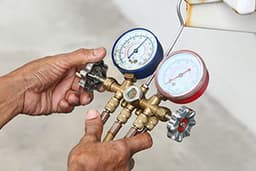
These are the city's most comfortable weeks, with nights around 22°C, and many ACs are switched off for the first time in months. It is the ideal moment for a deep service: coil chemical wash, blower removal and cleaning, condenser jet wash, refrigerant pressure check, capacitor test and a look at mounting brackets after months of monsoon wind. Units that will sit unused for weeks should be run in fan mode occasionally so bearings and seals do not seize.
Onam, Attukal Pongala and the Household Peaks
The city's festival calendar puts its own load on air conditioners. Onam in August or September brings extended families home into houses that may have run the AC lightly all monsoon, and suddenly it is needed in every bedroom. The Attukal Pongala in February or March, when the city fills with visitors, overlaps the start of the hot season, and guest rooms that have been shut for months get their AC switched on for the first time in the year. A check a week or two before either event prevents the awkward discovery of a dead unit with a house full of people.
Fault, Cause and Action Through the City's Year
| Fault | When It Peaks | Usual Cause in Thiruvananthapuram |
|---|---|---|
| Weak cooling, long run times | March to May | Mould-choked evaporator, dirty condenser, slow gas leak from corroded joint |
| Water dripping indoors | June to September | Algae-blocked drain, tray overflow in saturated air |
| Unit dead after a storm | April, May, October, November | Surge damage to PCB, fuse or varistor |
| Outdoor unit noisy or vibrating | Monsoon months | Corroded fan mount, rusted bracket, bearing failure |
| Sour smell on start-up | All year, worst after monsoon | Fungus on blower wheel and coil |
| Compressor cycling on and off | April to May | Weak capacitor, high head pressure from a dirty condenser |
| Fins crumbling on the outdoor coil | Visible by year three on the coast | Salt-air corrosion |
| Copper pipe sweating along the wall | June to November | Rotted insulation in constant damp |
Our Ten-Step AC Service Checklist
- Record supply voltage and test the stabiliser and surge protector under load.
- Measure compressor starting and running current with a clamp meter.
- Remove and wash filters; chemically clean the evaporator coil and the blower wheel.
- Jet wash the outdoor condenser from the inside out and straighten bent fins.
- Flush the drain line and confirm the pipe falls continuously to the outlet.
- Check suction pressure and the temperature drop across the indoor coil; test for leaks only if readings suggest one.
- Test the capacitor, contactor and fan motors; clean corroded terminals in the outdoor box.
- Inspect and, if needed, replace pipe insulation and tape.
- Check brackets, anchors and vibration pads, especially on sea-facing walls.
- Read inverter error history, test remote and swing, and explain every reading before quoting any part.
What We Do Not Do
We do not top up gas without finding the leak, because refrigerant in a sealed system does not get used up and a yearly top-up is a yearly bill for the same hole. We do not charge a system without first pulling a vacuum, which in this humidity would leave moisture inside to form acid. We do not replace a compressor when a capacitor or relay is the real fault. We do not claim a condenser coil corroded through in several places can be patched for long. And we do not present ourselves as any brand's authorised centre: AC Care India is an independent multi-brand repair service, brand names on this page only identify the units we work on, and an AC still inside its manufacturer's warranty should be taken to the brand first.
Inverter Units, Stabilisers and Where the Outdoor Unit Goes
Most ACs sold in the city in recent years are inverter models, and their outdoor PCB is the most expensive and most storm-sensitive part of the machine. A stabiliser alone does not stop a lightning surge; it manages slow voltage swings. For this city the combination that works is a stabiliser with a surge cut-off plus a separate surge protector on the AC line, fitted before April. Placement matters as much. In the tall apartment blocks near Technopark and along the bypass, outdoor units are stacked on sun-facing walls with little airflow, and head pressure rises until the compressor cycles on its overload. In independent houses, units tucked under a sunshade or behind a water tank breathe their own exhaust. On the coast the outdoor unit should face away from the sea if the wall allows, and its fins deserve a fresh-water rinse every few months. We check all of this on a service visit, because a well-placed unit needs fewer repairs than a perfectly serviced badly placed one.
Localities We Serve
Pattom, Kesavadasapuram, Ulloor, Sreekaryam, Kazhakoottam, Technopark, Kulathoor, Kowdiar, Vellayambalam, Sasthamangalam, Vazhuthacaud, Jagathy, Thycaud, Thampanoor, East Fort, Chalai, Manacaud, Karamana, Poojappura, Thirumala, Vattiyoorkavu, Peroorkada, Nalanchira, Mannanthala, Shanghumugham, Kovalam and Vizhinjam.
Brands and Unit Types
Split, window, cassette and inverter units from Daikin, Blue Star, Voltas, Samsung, Hitachi, Carrier, Lloyd, O General, Panasonic, Godrej, Whirlpool and Haier. Verified technicians with gauge sets and vacuum pumps, a written quote before any part is opened, warranty on repair and parts, genuine or verified compatible spares, same-day or next-day visits in most of the city, and straight advice when an old unit is not worth saving.
Book AC Service in Thiruvananthapuram
Call or WhatsApp 9266608882, or book online through this page. Mention the locality, the brand, whether the unit is inverter or fixed-speed, and whether the outdoor unit faces the sea. In a city where the AC season runs ten months and the air never dries, a unit serviced in step with the calendar cools better and costs less to run.
