


Many People in Mau Believe an AC Just Needs Gas Every Summer. It Does Not.
Ask around Mau in April and you will hear the same plan from many households: get the AC's gas filled before the heat starts. It is treated like a seasonal ritual, the way you would service a cooler pump. The trouble is that an air conditioner is a sealed system. The refrigerant inside circulates in a closed loop and is not consumed. If an AC needs gas every year, it has a leak, and every top-up without fixing that leak is money spent on gas that will escape again.
What a Mau AC really needs before summer is cleaning, electrical checks and an honest look at any leak. The rest of this page explains why the local climate and power supply are so tough on ACs, what faults follow, and how AC service in Mau should be done properly.
Purvanchal Heat: Dry Furnace First, Then Sticky Steam
Mau has two summers. The first runs from April to mid-June, when hot westerly winds blow across the plains and May afternoons average around 42°C, with heat waves pushing higher. Outdoor units bake on rooftops and walls, and the condenser has to dump heat into air that is already extremely hot. Any dust on the coil, any shortfall of airflow, and cooling collapses in the afternoon.
The second summer arrives with the monsoon. From late June to September, temperatures fall a little, but humidity climbs sharply. Rooms feel stuffy at 33°C, and the AC is now working hard to pull moisture out of the air. Drain lines carry far more water, indoor coils stay wet for hours, and if the drain is partly blocked, water drips onto beds and walls. Mould grows on the blower wheel, and that is where the stale, damp smell in many Mau bedrooms in August comes from.
Taken together, the AC season here runs from roughly April to October, a good six months, and that is a long time for any machine to run without attention.
Power Cuts, Looms and Voltage Swings
Mau is famous for its sarees, and the powerloom industry is woven into the town itself. Looms run in homes and small workshops across many mohallas, often sharing the same transformers as residential connections. When the looms start and stop, and when the evening domestic load peaks, voltage swings noticeably. Long cuts are still a part of summer in eastern Uttar Pradesh, and when supply returns, it can come back with a surge.
For an AC, this means:
- Compressors starting on low voltage draw heavy current and heat their windings.
- Capacitors weaken faster under repeated hard starts.
- Stabiliser relays wear out, and a failing stabiliser can pass a surge straight through.
- Inverter AC outdoor boards, which are sensitive to spikes, fail more often.
There is also a quieter effect of the loom trade. Fine cotton and synthetic fibre lint floats in the air near weaving areas. It collects on indoor filters and, more seriously, mats onto outdoor coils along with ordinary road dust. A coil coated in lint holds heat like a blanket.
Narrow Lanes, Tall Houses and Where the Outdoor Unit Ends Up
The older parts of Mau are dense. Houses stand shoulder to shoulder along narrow galis, many are three or four storeys high, and the only place left for an outdoor unit is often a cramped balcony, a shared wall facing the neighbour's house a metre away, or a corner of the roof next to the water tank. Each of these spots has its problems.
When two outdoor units face each other across a narrow lane, each one breathes in the hot air the other throws out. Cooling suffers for both. On rooftops, units sit in full sun from morning to evening, and the metal casing can become too hot to touch by mid-afternoon. On balconies, units are often hemmed in by drying clothes, which block the airflow and add to the lint problem.
A few practical fixes we suggest during AC service in Mau:
- Give the outdoor unit at least a foot of clear space behind and in front.
- Where two units face each other, offset them or angle one if the wall allows.
- On roofs, raise the unit on a stand and add a ventilated shade above it.
- Keep clothes lines away from the condenser.
- Use proper wall brackets with anti-vibration pads; loose units on older brickwork shake and leak at the joints.
Getting placement right is one of the cheapest ways to add years to an AC in this town.
Symptoms Mau Households Report Most
| Symptom | Common Cause | Before You Call |
|---|---|---|
| Cools at night, struggles in the afternoon | Dirty condenser coil, weak condenser fan | Check that the outdoor unit is not boxed in |
| Compressor stops and starts every few minutes | Low voltage, weak capacitor, overload tripping | Check stabiliser output reading |
| Water dripping indoors | Blocked drain pipe, wrong slope | Look for a kink in the outside drain pipe |
| Ice on the copper pipes | Low refrigerant from a leak, very dirty filter | Clean filters, switch off and call |
| Musty smell | Mould on coil and blower in monsoon | Run fan mode for 10 minutes after cooling |
| AC dead after a storm or a cut | PCB, fuse or stabiliser failure | Check MCB and stabiliser |
| Outdoor unit very noisy | Loose mounting, fan blade hitting, bearing wear | Switch off; do not run it |
What Our Technician Does During an AC Visit
Our visit begins at the power point, not the AC. The technician checks voltage at the socket, the earth connection, the MCB rating and the stabiliser's output and cut-off settings. In Mau, a surprising number of AC complaints turn out to be stabiliser or wiring issues.
Next comes the indoor unit: filters, evaporator coil, blower wheel and drain tray. Then the outdoor unit: condenser coil, fan motor, capacitor and the electrical connections inside the terminal box. Temperatures are measured at the indoor air intake and outlet so we know the real cooling difference.
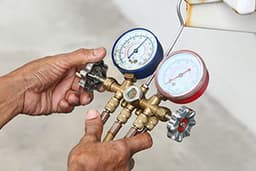
If a leak is suspected, we pressure test with nitrogen and find it before adding any refrigerant. After any gas work, the system is vacuumed and charged to the correct quantity.
You get a clear account of what we found and a written quote before repairs begin. After the work, the AC runs a full cycle while we check the readings with you.
Things You Can Do Yourself, and Things You Should Not
Safe for you:
- Wash the indoor filters every two weeks in the dry summer and weekly near loom areas.
- Keep the outdoor unit free of bags, clothes and plants.
- Run the AC in fan mode for a few minutes after switching off cooling during the monsoon.
- Switch the AC off at the wall during a thunderstorm.
- Set the temperature around 24 to 26°C, which is easier on the compressor and the bill.
Leave to a technician:
- Any work involving refrigerant or copper pipes.
- Opening the outdoor unit's electrical box.
- Replacing capacitors or PCBs.
- Relocating or reinstalling an AC.
- Repeated MCB tripping or a burning smell.
AC Brands We Handle in Mau
Voltas, Lloyd, Samsung, Daikin, Blue Star, Hitachi, Carrier, Haier, Godrej, Panasonic, Whirlpool and O General, across window, split and inverter split units. AC Care India operates independently and is not the official service centre of any brand listed here; the names only indicate which ACs we can service. For a unit covered by manufacturer warranty, contact the brand first.
With us you get identity-verified technicians, a quote before any repair, warranty on our work and fitted parts, genuine or tested compatible spares, same-day or next-day visits in most localities, and honest guidance when replacing is smarter than repairing.
Mau Mohallas and Areas We Serve
Bhiti, Sahadatpura, Azamgarh More, Gazipur Tiraha, Balnirmal, Chowk, Mirzahadipura, Dakshin Tola, Nizamuddinpura, Shahi Katra, Qasimpura, Malik Tahirpura, Musadpura, Imliya, Aurangabad and Tajopur. Ask about Kopaganj, Paharpura, Ghosi and Mohammadabad Gohna when you book.
Should You Repair Your AC or Replace It?
An AC under eight years old with a capacitor, fan motor, PCB or leak problem is almost always worth repairing. A compressor failure on a mid-life split is a closer decision, and we will set out the cost so you can compare it with a new unit. Old window ACs that still use R22 gas, have rusted base trays and draw heavy current are usually better replaced, especially given how many hours an AC runs in a Mau summer. A new, efficient inverter unit can pay part of its cost back through lower bills, provided it is protected from the local voltage swings.
Book AC Service in Mau
Book AC service in Mau online through this page, or call 9266608882. Share the brand, type and what the AC is doing, and pick a time that suits you.
