


Jalna's Winter Is Short and Mild, but Its Hard Water Works on Your Geyser All Year
Jalna does not have a north-Indian winter. Cold mornings arrive around late November, the coolest weeks of December and January bring nights of roughly 10°C, and by mid-February most families are bathing with tap water again. That means a geyser here is used intensely for a few months, mainly early in the morning, and sits idle or lightly used the rest of the year. Many homes also run a solar water heater on the terrace and use the electric geyser only as a backup on cloudy days or for late baths.
The water is the bigger story. Much of Jalna relies at least partly on borewells and tankers drawing from the region's basalt aquifers, and that water is often hard. Hard water scales up heating elements and tank bottoms whether the geyser runs for three months or twelve. Supply that arrives on fixed days, stored in overhead tanks that bake in the summer sun, adds sediment and temperature swings. So the question we hear most is a practical one: when the geyser plays up, is it worth repairing, or is it time for a new one? This page is organised around answering that, followed by how AC Care India handles geyser repair in Jalna.
Making the Call: Fix the Old Heater or Replace It
Look at the tank first
The inner tank is the heart of a storage geyser. If water is leaking from the body itself, rather than from a pipe joint or valve, the tank is usually corroded through, and that is rarely worth fixing. If the tank is dry and sound, almost everything else is repairable.
Consider age and history
A geyser under eight years old with its first major fault is almost always worth repairing. One that is older, has had its element replaced twice and now shows rust streaks on the body is nearing the end.
Think about how you use it
If your family uses hot water only for a few weeks of mornings each winter, a modest repair on an existing geyser is usually better value than a new one. If you have a joint family with elderly members who need hot water through the year, investing in a well-insulated new unit may make more sense.
Check safety, not just function
A geyser that gives a mild shock, trips the MCB or has a melted switch must be fixed or replaced before anyone uses it again. Safety outranks cost.
What Pushes the Repair Cost Up or Down
We do not publish fixed rates, because geyser jobs vary. These are the main factors:
- The part involved. A thermostat or a valve is a small job; an element plus descaling is more; a new tank is close to a new geyser.
- Scale and sediment. A tank packed with hard-water scale needs draining, flushing and descaling, which takes time.
- Anode rod condition. In hard water the magnesium anode is often fully consumed and needs replacing alongside the main repair.
- Wiring and earthing. If the socket has no earth or the wiring is undersized, it needs correcting before the geyser is safe.
- Access. Geysers mounted high in small bathrooms or above lofts take longer to bring down safely.
We always quote after diagnosis, before any work.
Common Geyser Faults in Jalna Homes
| Symptom | Typical Cause | Usual Repair |
|---|---|---|
| No hot water, indicator on | Element burnt out after scaling | Element replacement, descaling |
| No hot water, indicator off | Thermal cut-out tripped, wiring fault | Find root cause, reset or replace |
| MCB trips on switching on | Element leaking current, moisture in terminals | Insulation test, element replacement |
| Water lukewarm only | Thermostat fault, heavy scale on element | Thermostat replacement, descaling |
| Water scalding, valve dripping | Thermostat stuck on, valve scaled | Thermostat and valve replacement |
| Rusty or muddy water | Anode exhausted, sediment build-up | Anode replacement, tank flush |
| Crackling or popping sounds | Scale layer at tank bottom | Draining and descaling |
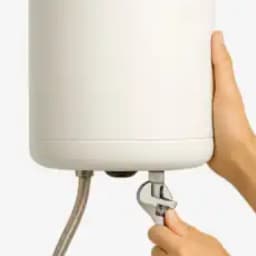
| Leak from pipe joints | Worn washers, loose connectors | Washer and connector replacement |
| Instant geyser weak | Element scaled, low water pressure | Element and inlet check |
Red Flags When Choosing a Geyser Technician
- He works on the geyser without first switching off at the MCB and testing the line.
- He replaces the element without checking why the old one failed.
- He never mentions the anode rod in a hard-water city.
- He bypasses the thermal cut-out to "make it work".
- He connects the earth wire to a water pipe instead of a proper earth point.
- He leaves without testing the pressure relief valve.
The last three are not just poor practice; they create a real risk of shock, scalding or a tank bursting under pressure. Ask for a written bill that lists the parts fitted, and keep it with the geyser's purchase papers for the next visit.
Our Repair Process
- Isolate power at the MCB and confirm with a tester.
- Check earth continuity and insulation resistance of the element.
- Inspect mounting, inlet and outlet joints and the pressure relief valve.
- Drain the tank and look at what comes out: scale flakes, mud or rust.
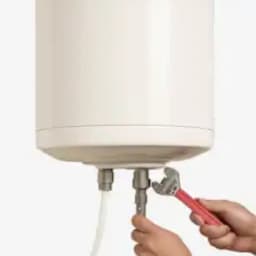
- Remove the element flange to inspect the element and anode rod.
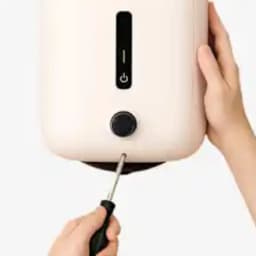
- Test thermostat and cut-out.
- Share the diagnosis and quote.
- Repair, descale if needed, refill, bleed air and test temperature at the tap.
The Right Time of Year for Geyser Work in Jalna
October and early November are ideal. The monsoon has passed, the geyser has sat largely unused through the hot months, and the cold mornings are a few weeks away. A service now catches elements weakened by scale and anodes consumed over the summer. If your home uses solar water heating, this is also a good time to check the solar unit's tank and pipes, since the electric geyser will take over on overcast winter days. A shorter check in March, when you switch the geyser off for the summer, lets you drain the tank so hard water does not sit in it for months.
Living With Hard Water and Short Winters: Practical Habits
A few simple habits extend a geyser's life considerably in Jalna conditions.
- Keep the thermostat moderate. Around 50 to 55°C is plenty for a bath. Higher settings speed up scale formation sharply in hard water and waste electricity.
- Switch on only when needed. Twenty minutes before the morning bath is usually enough for a storage geyser. Leaving it on all day in a mild climate is pure waste.
- Drain before summer. If the geyser will not be used from March to November, draining it stops hard water sitting in the tank and corroding the anode and element for eight months.
- Flush once a year. Opening the drain to let out sediment keeps the bottom of the tank clear.
- Check the anode every two years. In hard water it is often the first thing to go, and once it is gone the tank is next.
- Use a dedicated, earthed point. A geyser should have its own switch and MCB, with a proper earth connection, not a shared extension.
If you have a solar water heater
Solar heaters on Jalna terraces get plenty of sun, but the same hard water scales their tubes and tank. If your electric geyser is a backup to a solar system, the two share the same water problem. A combined check before winter saves you a cold bath on the first cloudy morning.
Water Heater Brands We Service
V-Guard, AO Smith, Racold, Bajaj, Havells, Crompton, Orient, Haier and Venus, in both storage and instant models. We also inspect gas geysers where they are used, with a firm focus on bathroom ventilation, because a gas heater in a closed bathroom can produce dangerous carbon monoxide.
Jalna Localities We Visit
Bhagya Nagar, Shivaji Nagar, Bajaj Nagar, CIDCO, Hadco, Kanhayya Nagar, Mahyco Colony, Sambhaji Nagar, Old Jalna, Sadar Bazar, New Mondha, Mama Chowk, Indewadi, Daregaon, Ambad Road, Mantha Road, Aurangabad Road, Prashanti Nagar, Ram Nagar and Nutan Wasahat.
Book Geyser Repair in Jalna
AC Care India sends verified technicians who carry elements, thermostats, anode rods and valves for popular brands. We quote before starting, give a warranty on repairs and parts, use genuine or reliable compatible spares, and visit most areas the same day or the next. If your geyser is past saving, we will say so.
AC Care India works independently on many brands of water heater. We are not an authorised service centre of any manufacturer, and brand names on this page only identify the products we service. If your geyser is still within the company's warranty period, contact the brand first.
Call 9266608882 or book online through this page, and tell us the brand, capacity and whether your home uses borewell, tanker or municipal water.
