

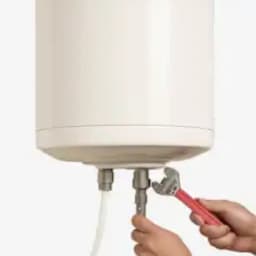




"Kolhapur Has Soft Water, So the Geyser Will Last Forever." Not Quite
It is a comforting belief, and half true. Water from the Kalammawadi reservoir and the Panchganga is low in dissolved salts, and a storage geyser in Rajarampuri or Tarabai Park does not scale the way one in Pune or Solapur does. But soft water is also slightly corrosive, and in this city it is the tank, the anode and the element sheath that go, not the scale. Add borewell supply on the city's outer colonies, which is a different and harder water, a monsoon that keeps bathrooms damp for four months, and wiring in the old peth houses that was never meant for a 2 kW load, and you have a set of geyser faults that are particular to Kolhapur. Geyser repair service in Kolhapur starts with those faults, so here they are in the order we meet them.
The Faults We Find Most in Kolhapur Geysers
Anode rod exhausted and the tank rusting
Soft, low-mineral water pulls metal from whatever it touches. The magnesium anode is there to be sacrificed, and in Kolhapur it goes faster than owners expect. Once it is gone, the tank lining pits and the hot water turns brown. We check the anode on every full service and replace it before the tank follows.
Element sheath corroded and leaking to earth
Rather than burning out under scale, the element here corrodes along its sheath until water reaches the coil. The ELCB or MCB trips the moment the geyser is switched on. A new element and a check of the earth connection fix it.
Thermostat drifting after the monsoon
Four damp months corrode the thermostat contacts in a bathroom that never dries. The result is either lukewarm water or a geyser that overheats until the pressure valve spits.
Scaled element and valve on borewell water
Kalamba, Uchgaon, Pachgaon, Gokul Shirgaon and Morewadi run on village schemes and private bores, and that water is hard. Here we see the classic scaled element, sediment at the tank bottom and a pressure valve jammed with lime.
Melted switch or socket in an old peth house
The wadas and older houses of Shivaji Peth, Mangalwar Peth and around Mahadwar Road often run the geyser from a shared socket on thin wiring. The socket browns, the switch melts, and in the worst case a leaking element puts current on the water. We treat wiring and earth as the first check.
Instant geyser flow sensor jammed
In small flats and PG rooms near Shivaji University and in Rajarampuri, instant geysers are common. Grit from the overhead tank jams the flow switch and the unit gives only a trickle of warm water.
Why This City Produces These Faults
Three things. Water: KMC supply is soft, which protects against scale but corrodes anodes, elements and tanks; the outer colonies are on hard groundwater, which does the opposite. Weather: the monsoon from June to September leaves bathrooms wet, and the ventilators in older houses are small, so thermostats, switches and terminals corrode. Winter is pleasant, with mornings around 12 to 14°C from December to February, so geyser use is real but short, mostly an early-morning bath for two or three months, and the unit then sits idle for the rest of the year. Idle months are when the anode dissolves unnoticed and the tank corrodes. Housing: a mix of century-old peth houses with inherited wiring and new apartment towers with long pipe runs from rooftop tanks that give low pressure on upper floors, which pressure-sensitive instant geysers dislike.
Storage, Instant and Gas: Which Fault Belongs to Which
Storage geysers of 10 to 25 litres are the norm in family homes across Rajarampuri, Tarabai Park and the peth houses, and their faults are the tank-related ones above: anode, element sheath, thermostat, sediment and the pressure valve. Instant geysers of 1 to 3 litres fill the small flats and PG rooms around Shivaji University, Vidyanagar and Rajarampuri's upper floors; they have no tank or anode, but their small element scales fast on borewell water, their flow switch jams with grit, and they draw more current than most old sockets can handle, which is why melted switches are an instant-geyser complaint far more than a storage one. Gas geysers survive in some older houses and in homes with LPG piped from a cylinder outside; they are cheap to run but a closed Kolhapur bathroom with a small ventilator is exactly where carbon monoxide builds up, and we treat ventilation as a condition of service, not a suggestion.
A word on energy, since winter is when the bill rises. A storage geyser set near 50 to 55°C instead of maximum loses less heat through the tank wall, corrodes more slowly and still gives a comfortable bath. Switch it on twenty minutes before use rather than leaving it on through the morning. Where the roof allows, a solar water heater does most of the work for eight months of the year in this city and the electric geyser becomes a backup for the monsoon and the coldest mornings; we service both.
How a Geyser Repair Visit Runs
- Earth continuity and insulation resistance tested with the geyser isolated.
- Socket voltage and element current measured; a partly corroded element draws oddly.
- Thermostat checked against a thermometer in the hot outlet.
- Tank drained to see sediment, rust flakes or lime.
- Anode rod removed and inspected, and shown to you.
- Pressure release valve tested under supply pressure.
- Mounting bolts and the wall checked, since a full tank in an old lime-plastered wada wall needs proper anchors.
- Diagnosis and quote given before any part is replaced.
- Repair, refill, heat test and leak check before we leave.
Parts and Pricing: What We Promise
Installation and shifting are part of the work. New geysers go up with proper anchors in the wall, a dedicated 16-amp point on its own MCB, a pressure valve facing the right way with a drain line, and a check that the rooftop tank gives enough head for the model chosen. When a family moves from a peth house to a flat on the Kalamba road, we drain, uninstall and reinstall the unit, and reset the thermostat for the new water.
We do not name a figure before seeing the geyser. A tripping breaker can be an element or a damp terminal, and the two cost very different amounts. What you get is the diagnosis and the cost before work, the old part in your hand, and a new genuine or verified compatible element, thermostat, anode or valve. Repairs and parts carry a warranty. If the inner tank is leaking from its body rather than a joint, we tell you it is not worth repairing, and we have no new geysers to sell you.
The Geyser Year in Kolhapur
| Months | What Is Happening | What to Do |
|---|---|---|
| March to May | Geyser mostly off; heat above 38°C | Drain it if unused for the summer, or run it once a fortnight |
| June to September | Monsoon damp; some use on cold wet mornings | Keep the bathroom ventilated; check the switch and socket for damp |
| October to November | Dry, pleasant; first regular use approaches | Book the annual service: anode, element, thermostat, earth test |
| December to February | Daily early-morning use | Set 50 to 55°C; switch on 20 minutes before use |
Localities We Serve in Kolhapur
Rajarampuri, Tarabai Park, Shahupuri, Nagala Park, Shivaji Peth, Mangalwar Peth, Shukrawar Peth, Mahadwar Road, Laxmipuri, Rankala, Kasaba Bawada, Ruikar Colony, Pratibha Nagar, Rajendra Nagar, Sane Guruji Vasahat, Phulewadi, Kadamwadi, Vidyanagar, Sambhaji Nagar, Kalamba, Uchgaon, Pachgaon, Morewadi, Shiroli and Gokul Shirgaon. Ichalkaranji, Kagal and Hupari by arrangement.
Geyser Brands and Types We Repair
Storage, instant and gas geysers from Bajaj, Racold, AO Smith, Havells, V-Guard, Crompton, Haier, Venus and Orient. Gas geysers survive in some older Kolhapur homes; we service the burner and ignition and check ventilation, because a gas geyser in a closed bathroom is a carbon monoxide hazard and we will not approve an unsafe one. AC Care India is an independent multi-brand appliance repair service, not the authorised service centre of any water heater brand; the names here only identify what we repair. A geyser within its company warranty should go to the brand first.
Reasons to Call AC Care India
- Verified technicians trained on water heater electrics and earthing.
- Elements, thermostats, anodes and valves for the common brands carried to the job.
- A quote before work begins.
- Warranty on the repair and the parts.
- Same-day or next-day visits in most areas.
- Honest advice when the tank is finished.
Book Geyser Repair in Kolhapur
Call or WhatsApp 9266608882, or book through this page with your locality, the geyser's brand and capacity, and whether you are on KMC supply or a borewell. The soft water will not save your geyser on its own; an October service will.
