

A Winter Morning in Vidya Nagar, and a Microwave That Hums but Will Not Heat
It is a foggy December morning in Bhiwani, a little after seven. The geyser has just finished, the children need to leave for school, and the glass of milk goes into the microwave for the usual ninety seconds. The light comes on, the plate turns, the fan hums, and the milk comes out exactly as cold as it went in. Nobody has time for this, so the oven gets pushed aside until the weekend. When it is finally opened up, the cause is one of a handful of parts that fail in a familiar way: a high-voltage diode, a fuse, a magnetron or a door switch.
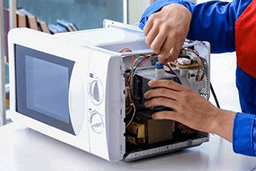
Understanding which part does what makes it easier to judge a repair quote. This page takes a microwave apart in plain language, explains how Bhiwani's conditions affect each section, and sets out how AC Care India carries out microwave repair in Bhiwani safely.
How a Microwave Oven Actually Heats Food
A microwave takes ordinary 230-volt mains power and steps it up to a very high voltage through a transformer, diode and capacitor. That high voltage drives the magnetron, which produces the microwaves. A waveguide channels them into the cooking cavity, where they make water molecules in food vibrate and heat up. Everything else, from the turntable to the touch panel, exists to control or support that process. Convection and grill models add heating elements and a hot-air fan on top of this.
The Magnetron
This is the heart of the oven. It is a vacuum tube with a magnet assembly and cooling fins. Magnetrons usually last many years, but they suffer when the cooling fan is weak, when the vents are choked with grease and dust, or when the oven is run empty. In Bhiwani kitchens, where summer room temperatures are already high and dust blows in during May and June, poor ventilation behind a built-in or tightly shelved microwave shortens magnetron life. A failed magnetron means a humming oven that does not heat, sometimes with a burning smell.
The High-Voltage Section: Transformer, Diode and Capacitor
This is the dangerous part of any microwave. The capacitor can hold a lethal charge even after the plug is pulled. It must never be opened by anyone without training and the right discharge tools. In our experience the high-voltage diode is one of the commonest failures, often after voltage surges. Bhiwani homes see frequent fluctuations, especially in the evening and when supply returns after a cut, and these spikes hit the high-voltage section hard. A shorted diode or capacitor usually blows the main fuse, so the oven appears completely dead.
Door Switches, Interlock and Fuse
Every microwave has two or three micro-switches that confirm the door is shut before the magnetron can fire. They are a safety system, not a convenience. Worn latches or a cracked door hook mean the switches do not close properly; the oven may stop mid-cycle, refuse to start, or blow its fuse repeatedly. We never bypass these switches. If the door hinge or seal is damaged, microwave leakage is possible, and we test for it.
Turntable, stirrer and cavity
The turntable motor is a small geared motor under the floor of the cavity. Spilled milk, dal and gravy seep through the coupler and jam it, which is why the plate stops turning. The cavity paint and the mica waveguide cover inside the oven are just as important. Food splatter baked onto the mica cover carbonises, and carbon conducts. That is the source of most sparking. Left alone, sparking burns a hole in the cover and can damage the cavity paint or the magnetron.
Control Board and Touch Panel
The PCB reads the keypad, runs the timer and switches the relays for the magnetron, grill and convection heater. Moisture from a steaming kitchen, dust, and especially surges during monsoon storms can damage relays and tracks. A keypad that responds only to hard presses, or a display with missing segments, usually points to a worn membrane or a board fault. Some boards can be repaired at component level; others need replacement.
Grill and convection parts
Convection models used for cakes, pizza and tandoori-style dishes have a heating element and a separate fan at the rear. The element can open-circuit with age, and the fan motor gathers grease. If your oven microwaves normally but will not bake, these are the first suspects.
How Bhiwani Kitchens Use Microwaves, and Why It Matters
In most Bhiwani homes the microwave is not a cooking appliance so much as a reheating one. Milk, chai, leftover sabzi, rotis wrapped in a cloth and the occasional packet of popcorn make up most of its work. That pattern is easy on the magnetron but hard on two other parts. Short, frequent runs mean the door is opened and shut dozens of times a day, so door switches and latches wear faster than the electronics. And reheating dal, kadhi and milk-based dishes in uncovered bowls splashes the cavity walls and the mica cover far more than baking ever does.
The summer heat adds its own pressure. When a kitchen sits at 40°C in the afternoon, the oven's cooling fan is pulling in air that is already hot, and the magnetron runs closer to its thermal limit. Ovens kept on top of the fridge are a particular concern, because the fridge's own warm exhaust rises straight into the microwave's vents. A separate shelf with space on all sides is better for both machines.
Winter brings a different habit: heating water for tea or a quick wash, sometimes in steel tumblers by mistake. Metal in a microwave is a common reason for a sudden spark and a damaged cover.
Three habits keep a microwave healthy here. Cover food with a microwave-safe lid. Wipe the inside, including the mica cover, with a damp cloth once a week. And plug the oven into a spike guard rather than a loose extension board shared with the fridge and mixer.
Checks We Run Before Quoting
- Safe discharge of the high-voltage capacitor before any internal work.
- Continuity test of the fuse, door switches and thermal cut-outs.
- Resistance and leakage tests on the diode, capacitor and transformer.
- Magnetron filament and insulation check.
- Water heating test: a measured cup of water heated for a fixed time to judge output.
- Inspection of mica cover, cavity paint and waveguide for burns.
- Keypad, display and relay function test.
- Microwave leakage check around the door once reassembled.
Parts, Expected Life and Early Warning Signs
| Component | Typical Life with Normal Use | Warning Sign |
|---|---|---|
| Magnetron | Around 7 to 10 years | Slow heating, buzzing, burning smell |
| High-voltage diode | Varies; often fails early after surges | No heating, fuse blowing |
| High-voltage capacitor | Many years if surge-protected | Loud hum, fuse blowing, no heat |
| Door switches | 4 to 8 years depending on use | Oven stops when door is touched, intermittent start |
| Turntable motor | 5 to 8 years | Plate stops or turns in jerks |
| Mica waveguide cover | Replace when stained or burnt | Sparks, crackling, black spots |
| Touch membrane | 5 to 7 years | Buttons need hard presses or do not respond |
| Convection heater | 6 to 10 years | Baking mode stays cold |
Installation, Shifting and Maintenance Plans
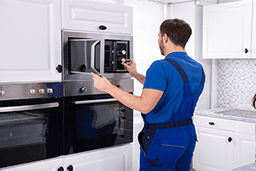
We fix wall brackets, check the socket and earth for a new oven, and set up built-in models with the ventilation gap the manufacturer specifies. Shifting within Bhiwani is common among government and university staff; we pack and check the oven before and after the move. Hostels, PGs, coaching centre canteens, sweet shops and small restaurants can opt for a maintenance arrangement with scheduled cleaning of the mica cover and vents, and priority callouts.
A quick safety rule for every home: if you see sparks, switch off, unplug and let the oven cool. Do not open the cover yourself.
Brands We Work On
Our technicians repair solo, grill and convection microwave ovens from Samsung, IFB, Panasonic, Whirlpool, Godrej, Bajaj and Morphy Richards. AC Care India is an independent workshop service for many brands, not an authorised representative of any; names are listed only to describe the products we fix. If your oven is under its original warranty, contact the maker first.
Our Coverage Across Bhiwani
We visit Vidya Nagar, Krishna Colony, Sector 23, Sector 13, Hanuman Dhani, Vijay Nagar, Ghanta Ghar, Halu Bazar, Jain Chowk, Rohtak Gate, Bawari Gate, Hansi Gate, Dadri Gate, Sainipura, Housing Board Colony, Loharu Road, Dinod Road and Devsar Road.
Schedule a Microwave Repair
With AC Care India you get a verified technician, a clear quote before any part is changed, warranty on the repair, genuine or properly matched spares, a visit on the same or next day in most areas, and an honest view if the oven is not worth fixing. Call or WhatsApp 9266608882, or book through this page with your oven's brand, type and the problem you have noticed.
