

"If the Microwave Lights Up, It Must Be Fine." Not Quite.
Most people in Sonipat assume a microwave is either working or dead. The light comes on, the plate turns, the timer counts down, so the oven must be healthy, and if the food stays cold, it is probably a bad bowl. In reality, the light, the turntable and the display all run on low voltage and can work perfectly while the part that actually heats your food has failed. A microwave that hums but does not heat is one of the most common calls we get, and the fault almost always sits inside the high-voltage section that you should never open yourself.
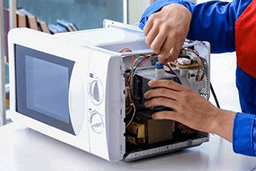
This page takes a microwave apart, section by section, so you understand what each component does, how Sonipat's heat, dust, power supply and kitchen habits wear it down, and what our microwave repair service in Sonipat checks before recommending any fix.
Inside the Box: How a Microwave Oven Heats Food
A microwave oven turns ordinary household electricity into high-frequency radio waves that make water molecules in food vibrate and heat up. Doing that safely needs several parts working together. When one weakens, the symptoms can be confusing.
Magnetron
The heart of the oven. It generates the microwaves and sends them through a waveguide into the cooking cavity. Magnetrons age with use and suffer when the oven is run empty, when the waveguide cover is greasy, or when the cooling fan is clogged and the magnetron overheats. In Sonipat summers, a microwave squeezed into a hot kitchen niche with poor ventilation runs its magnetron at the edge of its comfort zone.
High-voltage transformer, capacitor and diode
These step household power up to the several thousand volts the magnetron needs. The capacitor can hold a dangerous charge even after the oven is unplugged. Voltage spikes, which are common in Haryana when supply returns after a cut, can short the diode or puncture the capacitor. The usual sign is a loud hum with no heating, sometimes followed by a blown fuse. This section is not a DIY job under any circumstance.
Door interlock switches
Two or three micro-switches confirm the door is shut before the magnetron is allowed to fire. They are a safety system. Slamming the door, a sagging hinge or a cracked latch hook from years of daily use wears them out. A failed interlock often blows the main fuse, and the oven appears completely dead.
Waveguide cover and cavity paint
The small mica or plastic sheet on the cavity wall protects the waveguide opening. When it soaks up oil splatter from reheated sabzi or curry, it can char and spark. Chipped paint inside the cavity exposes bare metal that arcs too. Sparking is a warning to stop using the oven until it is fixed.
Turntable motor and roller ring
A small low-voltage motor turns the glass plate. Spilled dal or milk running down into the coupling slowly jams it. A plate that turns in one direction then stops, or does not turn at all, is usually the motor or the roller ring.
Control board and touch panel
Modern microwaves run on a PCB with a membrane keypad. Moisture from steam, monsoon humidity and grease build up on the panel. Surges during thunderstorms damage the board. Unresponsive buttons, ghost beeps and random resets point here.
Convection heater and grill element
Convection and grill models add a heating element and a fan to brown and bake. Families who bake cakes during the winter and festival months, or grill paneer tikka for guests, use these parts hard. Elements burn out and the convection fan motor can seize from grease.
Cooling fan, thermal fuses and main fuse
The fan keeps the magnetron and transformer cool. Sonipat's fine dust, especially in the dry pre-monsoon months and the post-harvest smog season, clogs its vents. Thermal fuses cut power when something overheats, and a tripped one often means another part caused the overheating in the first place.
What Sonipat Conditions Do to a Microwave
Summers here regularly cross 44°C, and kitchens in top-floor flats and older houses get far hotter than the outside shade. The microwave's internal fan is pulling in hot air, so components run warmer. The supply in many parts of the city sags in the evening and spikes when power returns after a cut, which is exactly what high-voltage parts dislike. The monsoon brings humidity and lightning. Winters bring heavy use for reheating and for convection baking during festivals. And year-round, a light film of dust gets everywhere. None of this is unusual for the NCR, but together it explains why the same failures repeat across the city.
How Our Technicians Diagnose a Microwave
- Check the socket voltage and earth connection before anything else.
- Run a timed water heating test to measure whether, and how well, the oven is actually heating.
- Unplug, wait, and safely discharge the high-voltage capacitor with the proper tool before opening the cabinet.
- Test the main fuse, thermal fuses and door interlock switches with a meter.
- Check the high-voltage diode, capacitor and transformer windings.
- Measure the magnetron filament continuity and check for shorts to the body.
- Inspect the waveguide cover, cavity paint and door seal for arcing marks.
- Test the turntable motor, cooling fan, lamp and, on convection models, the heater and fan.
- Check the control board and keypad response.
- After repair, perform a microwave leakage check around the door with a detector.
Component Lifespan and Early Warning Signs
| Component | Typical working life | Warning sign to watch |
|---|---|---|
| Magnetron | Often 7 to 10 years with normal use; shorter if run empty | Food takes longer, uneven heating, burning smell |
| High-voltage diode and capacitor | Can fail at any age after a surge | Loud buzz with no heating, fuse blowing |
| Door interlock switches | 5 to 8 years depending on door handling | Oven dead after closing door, intermittent start |
| Waveguide cover | Depends on cleaning; can char within a year if greasy | Sparks or crackling on one side wall |
| Turntable motor | 5 to 7 years | Plate stops, jerks or turns noisily |
| Touch panel and PCB | Varies widely; humidity and surges shorten it | Unresponsive keys, random beeps, blank display |
| Convection heater | 4 to 7 years with regular baking | Oven heats in microwave mode but not convection |
When a Repair Stops Making Sense
Most microwave faults are worth fixing. Fuses, interlocks, turntable motors, waveguide covers, diodes and capacitors are modest repairs that give an oven years more life. The calculation changes in a few situations:
- The magnetron has failed on a basic solo oven that is already eight or nine years old. The part plus labour can approach the price of a new entry-level model.
- Rust has eaten through the cavity floor or walls. Rusted cavities arc and cannot be made safe with paint alone.
- The door glass is cracked or the door frame is bent, so it no longer seals evenly.
- The main board for an older imported model is discontinued and unavailable.
In those cases we explain the options and leave the decision to you. We never charge for parts we did not fit.
Installation, Shifting and Regular Care
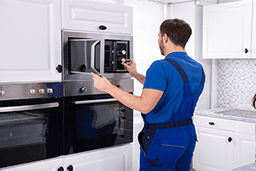
A microwave needs breathing space. Leave several centimetres around the sides and above, more for built-in and convection models. Plug it into a dedicated, earthed socket, not an extension board shared with a mixer or kettle. If you are moving to a new flat in Sonipat, carry the glass plate separately and keep the oven upright. We can install built-in models into modular kitchens, check the cut-out ventilation and confirm the socket wiring is safe. Offices, PGs near the university campuses at Rai and small eateries along the Murthal stretch, where microwaves run all day, can ask us about periodic checks.
At home, wipe the cavity after spills, keep the waveguide cover clean, never run the oven empty, and use only microwave-safe containers. No steel tiffins, no foil edges, no gold-rimmed crockery.
Microwave Brands We Repair
Solo, grill and convection microwaves from Samsung, IFB, Panasonic, Bajaj, Godrej, Morphy Richards and Whirlpool. AC Care India is an independent multi-brand repairer, not an authorised service centre for any of these companies; their names are used only to identify the ovens we work on. For an oven still under warranty, please contact the manufacturer first.
Neighbourhoods We Serve in Sonipat
Sector 23, Sector 15, Model Town, Mahavir Colony, Kalupur, Old Sonipat, Railway Road, Patel Nagar, Ashok Vihar, Sector 7, Sector 10, Gohana Road, Delhi Road, Bahalgarh, Murthal, Rai, Kundli, TDI City, Sector 27 and Ganaur.
Book Microwave Repair With AC Care India
Every visit comes with a background-checked technician, a quote you approve before work, a warranty on the repair and parts, and genuine or compatible spares. We aim for same-day or next-day service in most localities, and if a repair would cost more than the oven is worth, we will say so. Call or WhatsApp 9266608882, or book through this page with your locality, oven brand and model type.
