

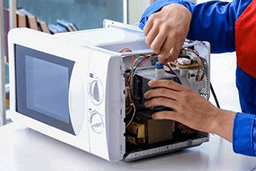


A Foggy January Morning in Model Town, and the Microwave Won't Heat
It is 7:15 on a cold January morning in Yamunanagar. Fog has not lifted, the geyser is busy, and someone in the family puts last night's dal and two rotis in the microwave to warm before the school bus comes. The turntable spins, the light is on, the timer counts down. Two minutes later the food is as cold as it went in. This is one of the most common microwave failures we see, and it almost always points to the high-voltage side of the oven: the magnetron, the high-voltage diode or the capacitor. None of those are parts anyone should touch at home.
A microwave in Yamunanagar has a different workload in each part of the year, and the faults follow that pattern. Below we go season by season, then list the typical faults and causes, our service checklist and the limits of what we will do, before explaining how to book microwave repair in Yamunanagar with AC Care India.
March to June: Heat, Dust and Voltage Drops
Summer in Yamunanagar regularly pushes past 42°C, and kitchens without cross-ventilation get much hotter. A microwave sitting on a fridge top or inside a tight cabinet cannot get rid of its own heat; the cooling fan pulls in dusty air, and the magnetron runs warmer than it should. Thermal fuses blow, and an overheated magnetron loses output gradually. You notice it as longer heating times rather than a sudden failure.
Evening voltage dips in peak summer also matter. A microwave on low voltage delivers less power and strains its transformer. On the other side, a sudden surge when supply returns after a cut can damage the control board or the touch panel.
What we do in this season
Clean the cooling vents and fan, check the thermal fuses and the magnetron's cooling fins, and advise on placement so there is enough clear space around the cabinet.
Placement habits that save a magnetron
Keep at least a few inches clear on the sides and top of a countertop oven, and more at the back where most models exhaust hot air. Do not place it right next to the gas stove, where flame heat and oil vapour reach the vents. If it sits on the fridge, make sure the fridge top is not also where the fridge's own heat escapes. A microwave plugged into the same extension board as an induction cooktop or electric kettle sees voltage dips every time those switch on; a separate earthed socket is far better.
July to September: Damp Kitchens and Sparking
The monsoon brings humid air and steam that never quite leaves the kitchen. Moisture condenses inside the oven cavity and around the waveguide cover, the small mica sheet on the inside wall. Food splatter mixed with damp turns that cover greasy and carbonised, and the next time the oven runs, it sparks. Rust also starts where the cavity paint is chipped. Sparking is a sign to stop using the oven until it is checked, because continued arcing damages the magnetron.
Pre-monsoon and monsoon thunderstorms bring lightning surges. Ovens left plugged in during a storm can lose their control board, which shows up as a dead display or a keypad that does not respond.
What we do in this season
Replace the waveguide cover, treat or repaint small rust spots with microwave-safe cavity paint, check door seals and interlocks, and test the control board and power supply.
October and November: Festival Cooking and Heavy Use
Dussehra, Karva Chauth, Diwali and the wedding season keep kitchens busy. Families who own convection microwaves bake cakes, make biscuits and roast snacks, and the convection heater and its fan work for long stretches. This is when convection elements burn out and turntable motors, worn by heavy dishes, finally stop. Smoke from stubble burning in the region and festive crackers also drifts indoors and coats the fan and vents.
What we do in this season
Test the convection heater, fan motor and thermostat, replace turntable motors and couplers, and clean the grill element and vents.
Baking without burning out the oven
Preheat only as long as the recipe needs, use the low rack supplied with the oven rather than any steel stand from the market, and let the oven cool between back-to-back batches of cake or nankhatai. Never run the empty oven in microwave mode to "dry it out"; with nothing to absorb the energy, the magnetron reflects power back on itself. Wipe the cavity and grill element after each baking day, because sugar and butter splatter caramelise and later start smoking or sparking.
December to February: Cold Mornings and Daily Reheating
Winter nights in Yamunanagar fall to around 4 or 5°C, and the microwave becomes a reheating workhorse for milk, tea, leftovers and baby food. Short, frequent cycles stress the door switches, because every open and close puts a load on the interlock system. A microwave that suddenly stops mid-cycle, or blows a fuse when the door is shut, usually has a faulty interlock switch or monitor switch. This is the season when the cold-food fault described at the top of this page is reported most, simply because the oven is used the most.
What we do in this season
Check and replace door interlock and monitor switches, test the high-voltage circuit safely after discharging the capacitor, and replace the magnetron or diode where needed.
Why you should never open it yourself
The capacitor inside a microwave can hold a lethal charge for a long time after the plug is pulled. The transformer produces several thousand volts. Online videos make these repairs look simple, but a slip with a screwdriver can kill. If your oven is not heating, unplug it, leave the cover on and call a trained technician. You can safely check the plug, the socket, the door closing properly and whether the turntable is seated correctly, and that is where home troubleshooting should end.
Microwave Fault Table: Symptom and Likely Cause
| What Happens | Probable Cause | Season It Peaks |
|---|---|---|
| Runs normally but does not heat | Magnetron, high-voltage diode or capacitor failure | Winter, after summer overheating |
| Sparks or crackling inside | Greasy or burnt waveguide cover, metal in dish, damaged cavity paint | Monsoon |
| Completely dead, no display | Blown main fuse, thermal fuse, surge-damaged board | Pre-monsoon storms, summer |
| Turntable not rotating | Turntable motor or coupler worn | Festival season |
| Stops when door is touched | Faulty door interlock switch or latch | Winter |
| Touch keys not responding | Membrane keypad or control board damaged by moisture | Monsoon |
| Convection mode not heating | Convection heater, fan or thermostat | Festival season |
Our 10-Step Microwave Service Checklist
- Check the socket voltage and earthing before opening anything.
- Unplug and safely discharge the high-voltage capacitor.
- Inspect and test all fuses, including thermal fuses.
- Test the door interlock, primary, secondary and monitor switches.
- Measure magnetron filament continuity and insulation.
- Check the high-voltage diode, capacitor and transformer windings.
- Inspect the waveguide cover, cavity paint and door seal.
- Test the turntable motor, cooling fan and lamp.
- Check the control board, keypad and, for convection models, the heater and thermostat.
- Run a water-heating test to confirm actual output after repair.
Work We Will Not Take On
We will not bypass a door interlock switch to make an oven "work", because that is the safety barrier between you and microwave radiation. We will not reuse a door that is bent, cracked or will not close flat. If the oven cavity is rusted through, we will tell you the unit is not safe and should be replaced rather than painting over it. And we will not install a magnetron of the wrong rating just because it fits. These limits protect your family, and they are not negotiable.
Yamunanagar Localities We Cover
Model Town, Sector 17, Prem Nagar, Professor Colony, Camp, Tejli, Sector 15, Sector 18, Gandhi Nagar, Gobindpuri, Rampura, Industrial Area, Workshop Road, Ambala Road, Radaur Road, Saharanpur Road, Jagadhri city, Buria Gate, Sector 7 Jagadhri and Hamida.
Microwave Brands We Service
Solo, grill and convection ovens from Samsung, IFB, Panasonic, Bajaj, Whirlpool, Morphy Richards and Godrej, including built-in models. AC Care India is an independent multi-brand repair service and is not the authorised service centre of any of these companies. Brand names are used only to say which ovens we repair; for a microwave still in its warranty period, go to the brand first.
Book Microwave Repair in Yamunanagar
Our technicians are verified and trained on high-voltage safety, you get a quote before work begins, repairs and parts come with a warranty, and most areas get a same-day or next-day slot. We will also tell you honestly if an old oven is not worth fixing. Call or WhatsApp 9266608882, or book online through this page.
