Parbhani's Long, Dry Summer Decides How Fast an Air Conditioner Wears Out
Parbhani sits in the heart of Marathwada, on the Deccan plateau, far from the sea. The hot season starts early in March and does not really ease until the monsoon arrives in June. In May the average daytime maximum is around 42°C, and heatwave days climb higher than that. Air is dry for most of the hot season, the wind carries soil from surrounding farmland and the cotton belt, and evening voltage dips as every cooler and AC in the colony starts at once. Then the monsoon brings thunderstorms and humidity, and October produces a short, sticky second summer.
For an air conditioner, that means months of near-continuous running, coils that collect dust fast, and electronics that face both heat and surges. The best way to understand an AC service in Parbhani is to look inside the machine, part by part, and see what this climate does to each one.
Inside Your AC: Each Part and How Parbhani Affects It
Compressor
The compressor in the outdoor unit pumps refrigerant around the system and does the heavy lifting. Its workload depends on the gap between indoor and outdoor temperatures. When it is 43°C outside and the family wants 24°C in the bedroom, the compressor runs long, hot cycles. Low voltage makes it draw more current to do the same work, which raises winding temperature. Compressors rarely fail suddenly without warning; they usually suffer for years from dirty coils, low voltage and weak capacitors first.
Condenser coil and outdoor fan
The condenser releases the heat taken from your room. Its thin aluminium fins are a magnet for Parbhani's fine dust and for cotton fibre during the ginning season, when the air around the market areas and ginning units carries lint. A matted coil traps heat, so the compressor runs hotter and longer. The outdoor fan motor's bearings also dry out in this heat; a slow or noisy fan is a common finding.
Expansion device and refrigerant
A capillary tube or electronic expansion valve controls refrigerant flow into the indoor coil. Refrigerant itself is not used up; it circulates in a sealed loop. If the level is low, there is a leak, usually at a flare nut, a brazed joint or a vibrating pipe that has rubbed through.
Evaporator coil and blower
Inside the room, the evaporator absorbs heat and the blower wheel pushes cooled air out. A dusty filter lets dirt reach the coil, cutting airflow. In the monsoon, a dirty coil and blower grow mould and produce that musty smell when the AC starts.
PCB and inverter drive
The indoor PCB reads sensors and the remote. Inverter ACs also carry an outdoor drive board that controls compressor speed. These boards dislike voltage spikes from storms and feeder switching, and they dislike heat. A sun-baked outdoor unit on a terrace in Parbhani in May can have a very hot electrical compartment.
Capacitors, contactor and relays
Capacitors help start and run the compressor and fan motors. Heat dries them out. A weak capacitor causes hard starts, humming and tripping. The contactor in non-inverter units can pit and stick after thousands of on-off cycles.
Drain system
Condensate from the indoor coil drains through a tray and pipe. In dry months there is little water and dust settles in the pipe; when humid weather arrives, that dust becomes sludge and blocks it, causing indoor leaks.
Sensors
Room and coil thermistors tell the board what is happening. A faulty sensor can make an AC stop cooling early, run endlessly, or show an error code.
Diagnostics We Run Before Recommending Any Repair
- Supply voltage at the socket, idle and under compressor load.
- Compressor and fan motor current compared with the nameplate.
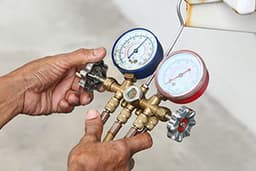
- Suction and discharge pressure readings with a gauge set.
- Supply and return air temperatures to confirm actual cooling.
- Capacitor value test with a meter, not by guess.
- Error code reading and sensor resistance checks on inverter models.
- Insulation test on compressor windings when tripping is reported.
- Leak detection with nitrogen pressure and bubble solution where gas is low.
- Visual check of copper pipe insulation, brackets, wall seal and drain slope.
Typical Life of AC Parts and the Signs They Are Going
| Component | Expected life under Parbhani conditions | Early warning sign |
|---|
| Run capacitor | 3 to 6 years; heat shortens it | Humming, slow start, MCB tripping |
| Outdoor fan motor | 6 to 10 years | Fan spins slowly, outdoor unit very hot, noise |
| Indoor blower motor | 8 to 12 years | Weak airflow, rattling indoors |
| Inverter drive board | Varies; storms and heat cut it short | Error codes, compressor not starting |
| Thermistors | 5 to 10 years | AC stops cooling early or runs constantly |
| Compressor | 10 to 15 years with clean coils and stable voltage | High current, overheating, loud knocking |
| Copper pipe insulation | 4 to 6 years in sun | Cracked, flaking foam, sweating pipes |
Gas Charging: Leak First, Refill Second
Some technicians top up gas every summer and leave. That is not a repair. If your AC has lost refrigerant, it has a leak, and the leak will empty the new gas too. Our technicians pressurise the system with dry nitrogen, find the leak, repair it by brazing or remaking the flare, pull a vacuum to remove moisture and air, and only then charge the correct amount of the right refrigerant for your model. Mixing gases or overcharging damages the compressor.
Why Placement Matters So Much in Parbhani Homes
Many homes in Parbhani are independent houses of two or three floors with a flat terrace on top. The outdoor unit often ends up on that terrace in full sun, sometimes boxed in by a parapet wall. Others are mounted on a west-facing wall that absorbs the afternoon heat. Either way, the unit is breathing air that is several degrees hotter than the shaded street.
A simple, well-ventilated shade over the outdoor unit, kept at least a foot clear of walls on the air outlet side, can make a noticeable difference to cooling and power consumption. Raising the unit slightly off a hot concrete slab helps too. We advise on this during every installation and many services.
Voltage, Load-Shedding and Your AC's Electronics
Power supply in Parbhani has improved, but households still describe evenings when lights dim, fans slow and the AC struggles to start. Feeder trips during summer peaks and monsoon storms are common enough that most families keep an inverter battery for lights and fans. Air conditioners are not usually on that backup, so they experience every cut and every restoration.
When power returns after a cut, it can return with a spike. A fixed-speed AC whose compressor tries to restart immediately against high pressure can trip or overheat. That is why a stabiliser with a built-in time delay of a few minutes is valuable here. Inverter ACs handle a wider voltage range, which is one of their selling points, but their boards are costly and still benefit from good surge protection and solid earthing.
A few practical habits help: switch the AC off at the remote and the MCB when you know a cut is coming or a storm is overhead; wait a few minutes after power returns before switching it on; and ask our technician to check the earth at your AC point, especially in older houses where earthing was never tested.
Off-Season Care Between November and February
Parbhani's winter is short and pleasant, with cool nights and occasional cold snaps. Many ACs sit unused for three or four months. Cover the outdoor unit loosely to keep dust and bird droppings out, but never wrap it airtight, which traps moisture. Run the AC in fan or cool mode for ten minutes once a month to keep seals supple and the drain clear, and book your pre-summer service in February before the March rush begins.
Installation, Relocation and Maintenance Contracts
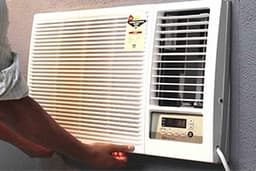
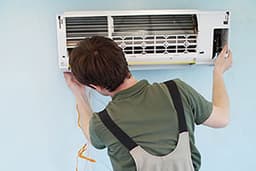
We install split and window ACs with proper core cutting, copper piping, brackets, sealed wall openings and a drain that slopes correctly. When you shift house within Parbhani, we pump the gas down into the outdoor unit, dismantle safely and reinstall at the new place, checking for leaks afterwards. Offices, clinics, banks and shops can opt for an annual maintenance contract with pre-summer and post-monsoon services and priority visits in the hottest weeks.
Brands We Service
Split, window and cassette air conditioners from Voltas, Lloyd, Daikin, Samsung, Blue Star, Godrej, Carrier, Hitachi, Whirlpool, Panasonic, O General and Haier, inverter and fixed-speed alike.
Parbhani Neighbourhoods on Our Route
Vasmat Road, Jintur Road, Station Road, Shivaji Nagar, Vishnu Nagar, Kadrabad Plot, Gangakhed Road, Pathri Road, Karegaon Road, Navamondha, Juna Mondha, Gandhi Park, Shanivar Bazar, Dev Nandra, Asola, Kali Kaman, the agricultural university side and the MIDC area.
Book AC Service in Parbhani
Why customers choose AC Care India: verified, trained technicians with proper tools; a quote you see and approve before work; warranty on repairs and parts; same-day or next-day visits in most localities; and unbiased advice on repair or replacement. We are an independent multi-brand appliance repair service and not the authorised service centre of any manufacturer. Brand names here only indicate the units we repair, and an AC under its maker's warranty should be referred to the brand first.
Call or WhatsApp 9266608882, or book through this page.