

Heat, Dust and Evening Voltage Dips: What Dewas Does to a Microwave
Dewas sits on the Malwa plateau with summers that regularly push past 40°C from April to June, dry months when fine black-soil dust settles on every kitchen shelf, a monsoon that brings humidity and thunderstorms, and a power supply that can sag in the evening peak and spike when it returns after a cut. A microwave oven lives through all of that in a kitchen that is often the hottest room in the house. Its cooling fan pulls in warm, dusty air; its control board takes every surge; and its high-voltage section works harder when supply voltage is low.
So when a microwave in the city stops heating, sparks, or goes dark, the question most owners ask is a practical one: is it worth repairing, or should we buy a new one? This page answers that clearly, explains what drives repair costs, lists common faults and shows how to choose a reliable technician for microwave repair in Dewas.
Repair or Replace? Work Through These Questions
- What is the age of the oven? Up to six or seven years, nearly every fault is worth repairing. Beyond ten, weigh the cost carefully.
- Which part has failed? Fuses, door switches, turntable motors, couplers and keypads are minor jobs. A magnetron or main board is more significant but still often sensible on a mid-range oven.
- What type of oven is it? A convection model that cost noticeably more than a basic solo oven usually justifies a bigger repair.
- Is the cavity intact? Surface rust or chipped paint can be treated. A cavity rusted through, or a door that no longer seals, usually means replacement.
- Are parts available? For mainstream brands, yes. For little-known imported ovens, boards may be hard to find.
If you answer "under seven years", "minor or mid-level part" and "cavity fine", repair is almost always the better choice.
What Pushes a Microwave Repair Bill Up or Down
We do not quote fixed prices on this page because the final cost depends on several things:
- The component involved. High-voltage parts such as the magnetron, transformer and capacitor cost more than low-voltage parts like fuses and switches.
- Oven type. Convection and grill models have extra heaters, fans and thermal fuses; built-in ovens take longer to remove and refit.
- Control style. Touch-panel and digital models use more complex boards than dial-operated ovens.
- Extent of damage. A surge may knock out a single fuse, or a fuse plus a board track plus a transformer.
- Genuine or compatible parts. We explain the difference and let you choose where both are reliable.
- Cavity work. Repainting a rusted patch with microwave-safe paint and replacing a burnt waveguide cover are small but separate tasks.
Microwave Faults We Commonly Find
| Fault | Probable Reason | What Fixes It |
|---|---|---|
| Runs but does not heat | Failed magnetron, HV diode or capacitor; weak transformer under low voltage | High-voltage section testing and part replacement |
| Completely dead | Blown main fuse, door interlock switch failure, surge-damaged board | Fuse and switch replacement, board repair |
| Sparking inside | Grease-soaked waveguide cover, chipped cavity paint, metal utensil | New cover, cavity touch-up, utensil advice |
| Turntable stuck | Broken coupler, failed motor, misplaced roller ring | Coupler or motor replacement |
| Keypad not responding | Worn membrane, dust in connector, moisture damage | Connector cleaning or keypad replacement |
| Convection mode cold | Open heater, tripped thermal fuse, convection fan fault | Heater, fuse or fan replacement |
| Oven shuts off mid-cycle | Overheating from a dusty fan or blocked vents, faulty thermal cut-out | Fan cleaning, vent clearance, cut-out replacement |
How Malwa Kitchens Actually Use Their Ovens
In most Dewas homes the gas stove still does the real cooking: dal bafla, poha, sabzi, puris and the endless frying of namkeen and snacks that Malwa is known for. The microwave is a support player, and its pattern of use shapes the faults we see. Reheating rotis, dal and leftover sabzi several times a day means many short cycles, which is hard on door switches and the turntable coupler. Warming milk and making tea in mugs leads to boil-overs onto the waveguide cover. Defrosting is less common than in meat-heavy regions, but quick-cooking corn, sweet potato and vegetables is popular, and those starchy splashes bake hard onto the cavity if not wiped.
Convection ovens have found a strong following among families who bake cakes for birthdays, make pizza for children and roast paneer tikka. These ovens run long, high-temperature cycles, which is exactly when a dusty cooling fan or blocked vent leads to the oven cutting out halfway. Students and working professionals in rented rooms, many commuting to Indore, often run a solo oven on a shared extension board alongside a kettle, an iron and a cooler, which is a recipe for scorched plugs and blown fuses.
Safety Points Every Household Should Know
- Never operate a microwave with a damaged door, broken hinge or a door that does not latch firmly.
- Do not remove the outer cabinet yourself. The high-voltage capacitor can hold a dangerous charge well after the plug is pulled.
- Plug the oven directly into a properly earthed wall socket rated for its load, not into a multi-plug.
- Stop using the oven at once if you smell burning plastic, hear a loud buzz, or see sparks with an empty, clean cavity.
- Do not heat sealed containers, whole eggs or foil-wrapped food.
How to Spot a Microwave Technician You Should Not Trust
Microwave repair involves components that store a lethal charge even after unplugging, so who opens your oven matters. Watch for:
- Someone who opens the oven without discharging the high-voltage capacitor or without unplugging it.
- A diagnosis of "magnetron gone" with no testing, especially when the oven is dead rather than not heating.
- Insistence on taking the oven away for a simple fuse or switch fault.
- No quote before work, or a bill that grows after the repair.
- Bypassing a door interlock switch "temporarily" to get the oven running. That is a serious safety hazard.
- Reluctance to show you the old part that was replaced.
Our Repair Process
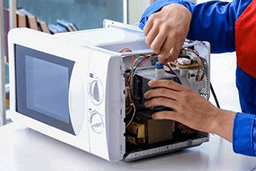
We start with your socket and earth, because a poor earth or loose plug causes many issues and creates a shock risk. With the oven unplugged, the outer cover is removed, the high-voltage capacitor is safely discharged, and then the tests begin: fuses, the three door switches, the magnetron, diode, capacitor and transformer, turntable and fan motors, the lamp, and on convection models the heaters and thermal fuses. The cavity and waveguide cover are inspected. After you approve the quote and the repair is done, we test heating with a cup of water, check door alignment and seal, and run a leakage check around the door before leaving.
Timing: When Dewas Microwaves Need Attention
Most failures here cluster around three periods. In May and June, kitchen heat plus low evening voltage makes high-voltage parts work hardest, and ovens on cluttered counters overheat. In June and July, the first thunderstorms of the monsoon cause surge damage to boards and fuses. Then in October and November, festival baking for Diwali and birthdays puts convection heaters and fans under heavy load. A quick check-up in March or September, cleaning the fan and vents, inspecting the waveguide cover and testing the door switches, catches many problems before those busy weeks.
Simple care between visits
Leave at least a hand's width of space around the oven's vents, wipe splashes from the cavity and waveguide cover after cooking, never run the oven empty, and unplug it during lightning.
Brands and Microwave Types We Repair
Our technicians repair solo, grill, convection and built-in microwave ovens from Samsung, IFB, Panasonic, Whirlpool, Bajaj, Morphy Richards and Godrej, including models with steam and air-fry functions. AC Care India is an independent, multi-brand repair service. We are not authorised by any oven manufacturer, and brand names are mentioned only to identify the appliances we service. If your oven is still within its warranty, please contact the brand first.
Where in Dewas We Come
Station Road, Civil Lines, Radhaganj, Moti Bungalow, Alkapuri, Vikas Nagar, Mishrilal Nagar, Nai Aabadi, Ganga Nagar, Tilak Nagar, Arjun Nagar, Shalini Road, AB Road, Mendki Road, Indore Road, Ujjain Road, Bhopal Road, Balgarh, Meetha Talab and the Industrial Area.
Book a Microwave Technician
When you book with AC Care India, a verified technician comes to you, the quote is shared before work begins, parts and labour come with a warranty, and most of the city gets a same-day or next-day slot. If an old oven is not worth fixing, we will tell you plainly. Call 9266608882 or book through this page, and share the brand, the oven type and exactly what it is doing, so the technician can bring the most likely parts on the first visit.
