

Why Does My Microwave Hum and Turn but Not Heat the Food?
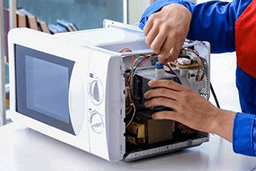
It is one of the most common questions we get from Khandwa households. The light comes on, the plate turns, the timer counts down, and the cup of chai or the bowl of leftover dal comes out exactly as cold as it went in. The usual answer is a failure somewhere in the high-voltage section: the magnetron, the high-voltage diode, the capacitor or the transformer. Occasionally it is a door switch telling the board that it is not safe to heat.
A microwave looks simple from outside, but inside it is a compact set of parts that each fail in their own way. This page explains those parts one by one, what the Nimar summer, dust and power supply do to each of them, and how AC Care India carries out microwave repair in Khandwa safely.
One safety point before anything else: the high-voltage capacitor inside a microwave can hold a dangerous charge even after the plug is pulled out. Please do not open the outer cabinet yourself.
The Magnetron and Its High-Voltage Circuit
The magnetron is the part that actually produces microwaves. It is powered by a high-voltage transformer, with a high-voltage capacitor and diode that roughly double the voltage. Together these four parts make up the heating circuit.
Magnetron
Magnetrons age with use. Heavy daily reheating, running the oven empty and blocked cooling vents all shorten their life. A worn magnetron heats weakly or not at all, and sometimes makes a loud buzzing sound.
High-voltage diode and capacitor
These are the parts most often damaged by voltage spikes. A failed diode can produce the classic hum-without-heat symptom, and a shorted capacitor often blows the main fuse as soon as you press start.
Transformer
A heavy, robust part that rarely fails, but long sessions in a hot kitchen can overheat its windings, especially if the cooling fan is weak.
In Khandwa, summer heat is a big factor. On May afternoons, many kitchens are already near 40°C before the microwave runs. Its cooling fan is pulling in hot air, so the magnetron and transformer run at higher temperatures than in milder cities. Keep at least a few inches of open space around the vents and avoid boxing the oven into a tight shelf.
Door Switches, Interlocks and the Turntable Drive
Every microwave has two or three micro-switches behind the door latch. They make sure the oven cannot heat with the door open. When one of them fails, the oven may refuse to start, stop mid-cycle, or blow its fuse as a safety measure. Door switches wear out from slamming, and a door with a bent hinge or broken latch hook stresses them further.
The turntable is driven by a small synchronous motor under the floor of the cavity. Spilled milk, oil and sugar syrup drip through the coupler and jam it. A plate that turns jerkily, or not at all, usually has a jammed coupler or a failed motor. Both are simple repairs.
The cavity's inner paint and the mica waveguide cover are also part of this zone. Grease splashes from reheated tadka dal or sabzi build up on the mica sheet and carbonise. Then the oven sparks inside, which can pit the cavity and eventually damage the magnetron. Replacing a stained mica sheet early prevents that.
The Control Board, Keypad and Sensors
The control board runs the display, timer, power levels and relays. It is the part most affected by the voltage swings and storm surges common in Nimar. Evening voltage often dips in summer when coolers and ACs load the local feeder, and pre-monsoon storms send spikes down the line when power trips and returns. A board can fail outright or develop a stuck relay that keeps the oven running.
Membrane keypads are another frequent complaint. Their thin layers crack and stop registering touches, sometimes only in one or two buttons. Steam from cooking and the humid monsoon months speed up this wear. Many keypads can be replaced as a separate part without changing the board.
Sensor models also have humidity or temperature sensors that decide cooking time automatically. If auto-cook programmes start undercooking or overcooking, the sensor may be dirty or failing.
Convection Fans, Grill Heaters and Combination Ovens
Convection microwaves have become popular in Khandwa homes for baking cakes, making pizza for children and roasting peanuts. They add a heating element and a fan at the back of the cavity, and often a quartz or rod grill on top. These parts carry their own risks: grill elements break from thermal shock if splashed with water, convection fans seize when grease builds up, and thermal fuses blow when the oven overheats in a hot kitchen. A convection oven that microwaves fine but will not bake usually has a fault in this separate circuit.
Fuses, Cooling Fan and Wiring: The Quiet Parts That Cause Loud Problems
The main ceramic fuse is designed to blow when something else fails, so a dead microwave with a blown fuse almost always has a second fault behind it: a shorted capacitor, a stuck door switch or a failing magnetron. Replacing only the fuse usually ends with the new fuse blowing within days. We always look for the cause.
The cooling fan keeps the magnetron and transformer within safe temperatures. In Khandwa's dusty months, its blades and the rear vents collect a layer of fine dust and kitchen grease, which slows the fan and raises internal temperature. Thermal cut-outs then trip, and the oven stops mid-cycle and restarts only after it cools down. Cleaning the fan and vents often solves what looks like an intermittent electronic fault.
Internal wiring connectors near the magnetron can brown and loosen from repeated heating. A loose spade connector arcs, smells of burning plastic and can damage the part it connects to. These are checked and tightened on every visit.
Tests We Run Before Quoting
- A safe discharge of the high-voltage capacitor before any other work.
- Continuity checks on the main fuse, thermal cut-outs and each door switch.
- Resistance tests on the magnetron filament, transformer windings and diode.
- A capacitance test on the high-voltage capacitor.
- Inspection of the mica cover, cavity paint and door seal for arcing marks.
- A water-heating test, measuring temperature rise over a fixed time, to judge actual output.
- Microwave leakage check around the door after repair, using a leakage meter.
- Function checks of keypad, turntable, light, fan, grill and convection modes.
Only after these tests do we give you the written quote.
Microwave Parts: Expected Life and Warning Signs
| Part | Typical Life With Daily Use | Warning Sign |
|---|---|---|
| Magnetron | Several years; shorter with heavy reheating and blocked vents | Weak heating, loud hum, burning smell |
| High-voltage diode | Variable; often fails after surges | Runs normally but does not heat |
| High-voltage capacitor | Long, unless hit by a spike | Fuse blows the moment you press start |
| Door switches | A few years with heavy slamming | Oven stops mid-cycle or will not start |
| Turntable motor and coupler | Many years if spills are cleaned | Plate stops or turns unevenly |
| Membrane keypad | Several years; less in steamy kitchens | Some buttons stop responding |
| Mica waveguide cover | Until grease carbonises on it | Sparks or blue flashes inside |
| Grill or convection heater | Several years | Grill or bake mode cold, smell of burning |
Installation, Relocation and Care Plans
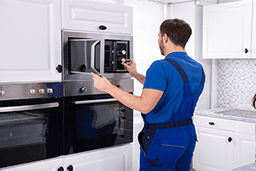
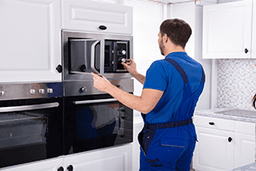
We fit built-in microwaves in modular kitchens, making sure the cabinet allows the airflow the manufacturer specifies, and we check that the socket is earthed. Many homes in Khandwa's older areas still have two-pin points in the kitchen. A microwave must be earthed; we will tell you if yours is not and suggest a correct point. When you shift house, we can uninstall and pack a built-in unit safely and refit it at the new address. Offices, canteens and small cafes can opt for periodic check-ups covering cleaning, door-seal checks and safety testing.
Microwave Brands We Service
Our technicians work on solo, grill and convection models from Samsung, IFB, Panasonic, Bajaj, Whirlpool, Morphy Richards and Godrej. AC Care India operates as an independent multi-brand repair service, not as an authorised centre for any manufacturer, and brand names are mentioned only to identify the ovens we repair. For a microwave still inside its company warranty, please contact the manufacturer first.
With us you get verified technicians, a written quote before repair, genuine or reliable compatible spares, a warranty on the work and parts, quick visits, and honest advice when an old oven is not worth a new magnetron.
Our Coverage Across Khandwa
We visit Indira Chowk, Sindhi Colony, Padam Nagar, Shivaji Nagar, Jawahar Nagar, Ram Nagar, Ghantaghar, Anand Nagar, Ganesh Talai, Moghat Road, Station Road, Bombay Bazar, Housing Board Colony, Jaswadi Road, Ganesh Nagar, Mata Chowk, Pandhana Road and the Railway Colony.
Book Microwave Repair in Khandwa
Call or WhatsApp 9266608882, or book through this page. Tell us the brand, whether it is a solo, grill or convection model, and what it is doing. Most microwave faults are diagnosed in one visit.
