

Nine at Night in Deendayal Nagar: The Microwave Hums, the Plate Spins, the Dal Stays Cold
It is a hot June evening in a second-floor flat in Deendayal Nagar. The ceiling fan is on full, the inverter is handling the usual evening cut, and dinner leftovers go into the microwave for two minutes. The light comes on, the turntable turns, the familiar hum fills the kitchen. The timer counts down to zero and the bowl comes out exactly as cold as it went in. Everything looks alive, and nothing is actually heating. This is the single most common microwave complaint we get from Gwalior, and it almost always points to one of three parts deep inside the cabinet that most owners have never heard of.
To understand what has gone wrong, and why Gwalior's heat, dust and uneven power make it go wrong faster, it helps to see how a microwave is built. This page on microwave repair in Gwalior takes the oven apart in words, section by section.
The Magnetron: Where the Heat Comes From
The magnetron is a vacuum tube that turns high-voltage electricity into microwaves at around 2.45 GHz. Those waves bounce around the metal cavity and make water molecules in food vibrate, which is what heats it. A magnetron has a limited life measured in hours of operation; a Gwalior household reheating rotis, milk and dal several times a day uses those hours faster than one that microwaves once a week. Cooling fins on the magnetron need airflow, and in a kitchen that sits at 40°C in May with the oven's vents coated in dust, the tube runs hot and ages early. When it fails, you get the exact scene described above: light, turntable, hum, no heat. It can also fail noisily, with a loud buzz and a burning smell.
The High-Voltage Section: Transformer, Capacitor and Diode
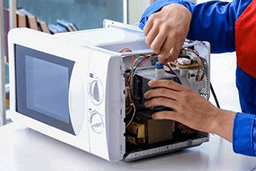
Between the wall socket and the magnetron sits a transformer that steps 230 volts up to several thousand, a capacitor that stores that charge, and a diode that shapes it. This is the part of a microwave that can kill. The capacitor holds a lethal charge for a long time after the oven is unplugged, which is why we discharge it with an insulated tool before touching anything else, and why no one should open a microwave at home with a screwdriver and a YouTube video. In Gwalior, the high-voltage diode is a frequent casualty of evening voltage spikes when the colony's load swings, and the transformer windings suffer in sustained summer heat. A failed diode or capacitor produces the same no-heat symptom as a dead magnetron, which is why diagnosis has to be done with a meter, not a guess.
The Mechanical Side: Door Interlock, Turntable and Cavity
Door switches and the interlock
Three small micro-switches sit in the door latch assembly. They tell the oven the door is shut and cut power instantly if it opens. These are mechanical, they are pressed thousands of times, and in a dusty city the latch wears and the switches start to chatter. The result is an oven that will not start, stops mid-cycle, or blows its fuse the moment the door closes. In older Gwalior kitchens where the microwave sits on a shelf at awkward height and the door is pulled open with a jerk, the latch hooks themselves crack. The interlock is a safety system, so we never bypass it; we replace the switches or latch.
Turntable motor, cavity and waveguide cover
A tiny synchronous motor underneath spins the glass plate so food heats evenly. It fails quietly: the plate stops turning and one side of the food scorches while the other stays cold. Spilled curry that runs down through the coupler into the motor is a typical Gwalior cause. Inside the cavity, the mica waveguide cover protects the magnetron opening from splatter. Once grease and masala soak into it, it carbonises and starts sparking. Sparks also come from chipped cavity paint, which exposes bare metal; monsoon humidity speeds up rust at those chips. Both are inexpensive to fix early and expensive if ignored, because arcing can damage the magnetron.
Control Board, Touch Panel and Fuse
The PCB runs the timer, the display and the relays that switch the high-voltage side on and off. The membrane touch panel on top of it is a sandwich of thin plastic that peels in heat and stops responding to certain keys, often the start key first. Gwalior's power is the PCB's enemy: a lightning surge during a July storm or a sharp spike when the supply returns after a cut can burn the relay or the board's own small transformer. The main fuse blows to protect everything downstream; if it blows again after replacement, the fault is elsewhere and we trace it rather than fitting a bigger fuse.
Convection heater, grill and fan
Convection and grill models add a heating element and a circulating fan. Many Gwalior families use convection mode for baking cakes and roasting during the winter festival weeks and barely touch it in summer. Elements fail from thermal cycling and from grease baked onto the coil; the fan motor collects dust through the rear vents and seizes. A convection oven that heats on microwave mode but not on bake mode has a heater or thermostat fault, not a magnetron fault.
Diagnostics We Run on Every Oven
- Visual inspection of the cord, plug and socket, and a check of the earth connection; a microwave on an unearthed socket is a shock hazard.
- Capacitor discharge before any internal work.
- Continuity test on the fuse, door switches and thermal cut-outs.
- Resistance test on the high-voltage diode, capacitor and transformer windings.
- Magnetron filament continuity and insulation test.
- Turntable motor and cooling fan operation under power.
- Inspection of waveguide cover and cavity paint for burn marks.
- Touch panel key-by-key test and PCB relay check.
- Water-load heating test with a timer and thermometer to confirm output after repair.
Part, Expected Life and the Warning Sign to Watch For
| Component | Typical Life in a Gwalior Kitchen | Early Warning Sign |
|---|---|---|
| Magnetron | 5 to 8 years with normal use; less with daily heavy reheating | Longer heating times, humming without heat, burnt smell |
| High-voltage diode | 4 to 7 years, shorter where voltage spikes are frequent | Sudden no-heat, loud hum, repeated fuse failure |
| High-voltage capacitor | 6 to 10 years | Loud buzzing, oven trips MCB |
| Door micro-switches | 3 to 6 years depending on use | Will not start, stops when door is touched, fuse blows on closing |
| Turntable motor | 4 to 8 years | Plate does not rotate, uneven heating |
| Waveguide cover | 2 to 4 years, less with oily cooking | Sparks, burn marks on the right wall of the cavity |
| Touch panel | 5 to 8 years | Some keys stop responding, display flickers |
| Convection heater | 5 to 8 years | Bake mode stays cold, smell of burning grease |
Installation, Shifting and Annual Maintenance
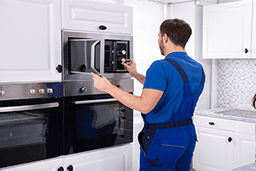
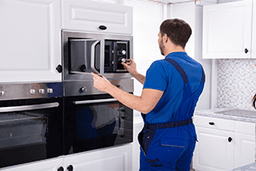
We install built-in and over-the-counter microwaves with the clearance the vents actually need, which matters in the compact kitchens of newer Gwalior flats where ovens are often shoved into a cabinet slot with no airflow. We check the socket rating and earth, and we advise on a stabiliser where the colony's supply is known to be rough. If you are shifting within the city, we pack, move and re-test the oven. For hostels, PG accommodations, cafes and offices in areas like City Centre and the university belt, an annual maintenance contract covers scheduled inspections and priority breakdown visits.
Microwave Brands We Repair
Solo, grill and convection ovens from Samsung, IFB, Panasonic, Whirlpool, Bajaj, Morphy Richards and Godrej. Magnetrons, diodes, capacitors, door switches, turntable motors, mica sheets and membrane panels are stocked for the common models.
AC Care India is an independent multi-brand repair service and holds no authorisation from any microwave manufacturer. The brand names above describe the products we work on, nothing more. An oven still within its manufacturer warranty should go to the brand's own service first.
Where in Gwalior We Come To
Deendayal Nagar, City Centre, Thatipur, Morar, Gole ka Mandir, Hazira, Lashkar, Jayendraganj, Phool Bagh, Kampoo, Naka Chandravadni, Bahodapur, Vinay Nagar, Tansen Nagar, Mahalgaon, Sirol, Jhansi Road, Shivpuri Link Road, Gandhi Nagar, Madhav Nagar, Govindpuri, Maharajpura, Basant Vihar and Kailash Vihar.
The AC Care India Difference
Technicians who are verified, trained on high-voltage safety and carry the right discharge tools. A clear quote before any part is replaced. Warranty on both the repair and the component. Genuine or correctly rated compatible parts, never a diode of the wrong rating because it was handy. Same-day or next-day visits in most of Gwalior. And honest advice: if the magnetron and transformer have both gone on a ten-year-old solo oven, we will say that replacement makes more sense.
Book Microwave Repair in Gwalior
Call or WhatsApp 9266608882, or book online through this page. Tell us the brand, whether it is a solo, grill or convection model, and what it is doing. Please do not open the cabinet yourself; the capacitor inside does not care that the oven is unplugged.
