







Three Quick Checks Before Booking AC Service in Gandhinagar
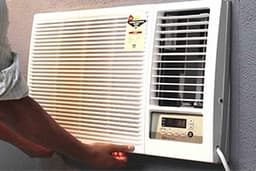
When the split AC in your Sector 21 flat or Kudasan tower starts blowing air that feels more like a ceiling fan than a cooler, run through this triage first. One: open the front panel and look at the mesh filters. In Gandhinagar's dry months they turn grey with fine dust in a matter of weeks, and a choked filter alone can halve the cooling. Two: step out to the outdoor unit and see whether the fan is spinning and whether the coil is coated in dust, bird nesting or a stray kite left over from Uttarayan. Three: check that the remote is in Cool mode, not Fan or Dry, and that the set temperature is sensible, around 24 to 26°C. If the room is still warm after a clean filter and the correct mode, the problem is inside the machine and needs a technician.
The rest of this page explains how the capital's climate treats an air conditioner, what we look for on a visit, and how AC Care India handles AC service in Gandhinagar.
A Semi-Arid Capital Where the AC Runs From March to October
Gandhinagar sits on the west bank of the Sabarmati in a hot semi-arid belt. From March to May, afternoon maximums usually sit between the mid-thirties and low forties, and heatwaves in May have pushed the mercury far higher; the city's recorded high is 48°C. Nights in May and early June often stay in the high twenties, so bedrooms need cooling through the night as well as the afternoon.
Then the monsoon arrives in mid-June and stays until mid-September, bringing most of the year's roughly 770 mm of rain in July and August. The air turns sticky, and many families keep the AC on for dehumidifying even when the temperature is moderate. October brings another warm spell before winter. In practice, a Gandhinagar AC works hard for seven to eight months and is idle for only the cool stretch from December to February.
Dust, Construction and the Outdoor Unit
Outside the monsoon, the region is dry, and dust is a constant companion. Wind from the open land around the city, the Sabarmati riverbed and the steady construction in GIFT City, Sargasan, Raysan, Koba and along the Sarkhej-Gandhinagar highway all put fine particles into the air. That dust settles on two places that matter. Indoors, it packs into the filter and the evaporator coil. Outdoors, it mats into the condenser fins, especially on units mounted on terraces or low parapets where traffic and building dust are heaviest.
A condenser that cannot shed heat raises the pressure inside the system. The compressor then draws more current, runs hotter and trips on overload during the hottest part of the afternoon. Many "AC cuts off at 3 pm" complaints we attend in the capital turn out to be nothing more than a coil that has not been washed since the last summer.
Power and voltage
Supply in the planned sectors is generally steady by Indian standards, but fringe villages and fast-growing localities at the end of long feeders can see voltage sag on peak summer evenings. Pre-monsoon thunderstorms also bring surges. Inverter ACs handle low voltage better than older fixed-speed units, but their control boards are more sensitive to spikes, so a stabiliser or surge protector is still worth having.
Towers, bungalows and government quarters
Housing in the capital comes in three broad types, and each treats an AC differently. The older sectors have government quarters and independent bungalows from the city's early decades, where wiring is often aluminium or undersized for a modern 1.5-ton load and the earth connection may be weak. The newer towers in Kudasan, Sargasan and Raysan have proper wiring but squeeze outdoor units into narrow service ledges or balcony corners, where hot exhaust recirculates. Terrace-mounted units in bungalows, meanwhile, bake in the full sun and collect the most dust. On every visit we look at where the outdoor unit sits and tell you plainly if a small change in position or a shade cover would help, because the location often matters more than the brand.
What You Notice vs What Is Usually Wrong
| Symptom | Typical Cause in Gandhinagar Homes | Fix |
|---|---|---|
| Cooling weak only in the afternoon | Dust-packed condenser, outdoor unit in direct sun with no airflow | Jet wash coil, improve clearance, check fan speed |
| Compressor stops and restarts repeatedly | Overload trip from high head pressure or a weak run capacitor | Measure current, replace capacitor, clean condenser |
| Water leaking indoors in July | Drain line choked with dust slurry, unit not level | Flush drain, re-slope pipe, clean tray |
| Unit dead after a storm | Blown fuse or surge-damaged PCB | Trace supply, test and repair or replace board |
| Ice on the suction pipe | Low refrigerant from a leak, blocked indoor coil | Leak test, repair, vacuum and charge by weight |
| Error code on display | Sensor, fan motor or communication fault on an inverter model | Read the code, test the named part |
| Rattling outdoor unit | Loose bracket, fan hitting debris, worn bearing | Tighten mounts, clear debris, replace motor if needed |
How a Service Visit Actually Runs
Our technician begins by asking what you have noticed and when. Then the readings come first: supply voltage at the socket, compressor current, and the temperature of air going in and coming out of the indoor unit. Those three numbers tell a lot before any panel is opened.
Next comes cleaning. Filters are washed; the indoor coil and blower are treated with coil cleaner and rinsed using a jet pump with a drain bag to keep your wall and bed dry. The outdoor condenser is washed from the inside out so dust is pushed away from the fins, not deeper into them. Bent fins are straightened.
After cleaning, electricals are checked: capacitor, contactor, fan motors, terminal tightness and earthing. Refrigerant pressure is measured with gauges. If it is low, we look for the leak before talking about gas. Finally, the unit is run for a while, the readings are taken again and you are shown the before-and-after figures.
Handle It Yourself or Call a Technician?
Safe to do yourself
- Wash the indoor filters every two to three weeks in the dusty months.
- Keep the outdoor unit clear of boxes, plants, cloth and kite string.
- Reset the MCB once if the AC trips; if it trips again, stop.
- Change remote batteries and check the mode before assuming a fault.
Leave to a technician
- Any gas-related work, including leak repair and charging.
- Opening the outdoor unit's electrical compartment or touching the PCB.
- Repeated MCB trips, burning smell or sparking at the plug.
- Moving the unit or changing the copper pipe length.
Brands Our Technicians Work On
We service split and window units from Daikin, Voltas, Blue Star, Samsung, Lloyd, Carrier, Hitachi, Panasonic, Haier, O General, Godrej and Whirlpool, both inverter and fixed-speed. For inverter models we read error codes and test sensors and boards rather than guessing.
AC Care India is an independent repair service working across many brands. We are not an authorised service centre for any of these companies, and their names are used only to say which machines we repair. An AC still covered by the manufacturer's warranty should go to the brand first.
Sectors and Neighbourhoods Covered
Sector 2, Sector 3, Sector 5, Sector 8, Sector 11, Sector 13, Sector 16, Sector 19, Sector 21, Sector 23, Sector 27, Sector 29, Kudasan, Sargasan, Raysan, Koba, Infocity, GIFT City, Randesan, Pethapur, Adalaj, Urjanagar and Chiloda.
Should You Repair or Replace an Old AC?
Most AC faults are worth repairing: capacitors, fan motors, sensors, drain issues, a single leaking joint and many board faults. The decision gets harder when the compressor fails on a unit more than ten years old, or when the coil has developed multiple leaks. At that point the repair bill, plus the running cost of an older fixed-speed machine through a Gandhinagar summer, often makes a new inverter unit the better buy. We give you the repair cost honestly and leave the choice to you.
Why People Choose AC Care India
- Technicians are verified and carry gauges, a clamp meter and a vacuum pump.
- The price is agreed before any part is fitted.
- Work and spares come with a service warranty.
- Visits are usually the same day or next day across most sectors.
- Original or matched-specification parts, never unknown spares.
Book Your AC Service in Gandhinagar
Call or WhatsApp 9266608882, or book online through this page. Share your sector or locality, the AC brand and the problem you have noticed. A pre-summer service in February or early March is the smartest booking you can make in this city, before the heat and the queue arrive together.
